Multi-Domain GDPR/ePrivacy and CIPA-Oriented Website Tracking Review for a Global Life Sciences Group
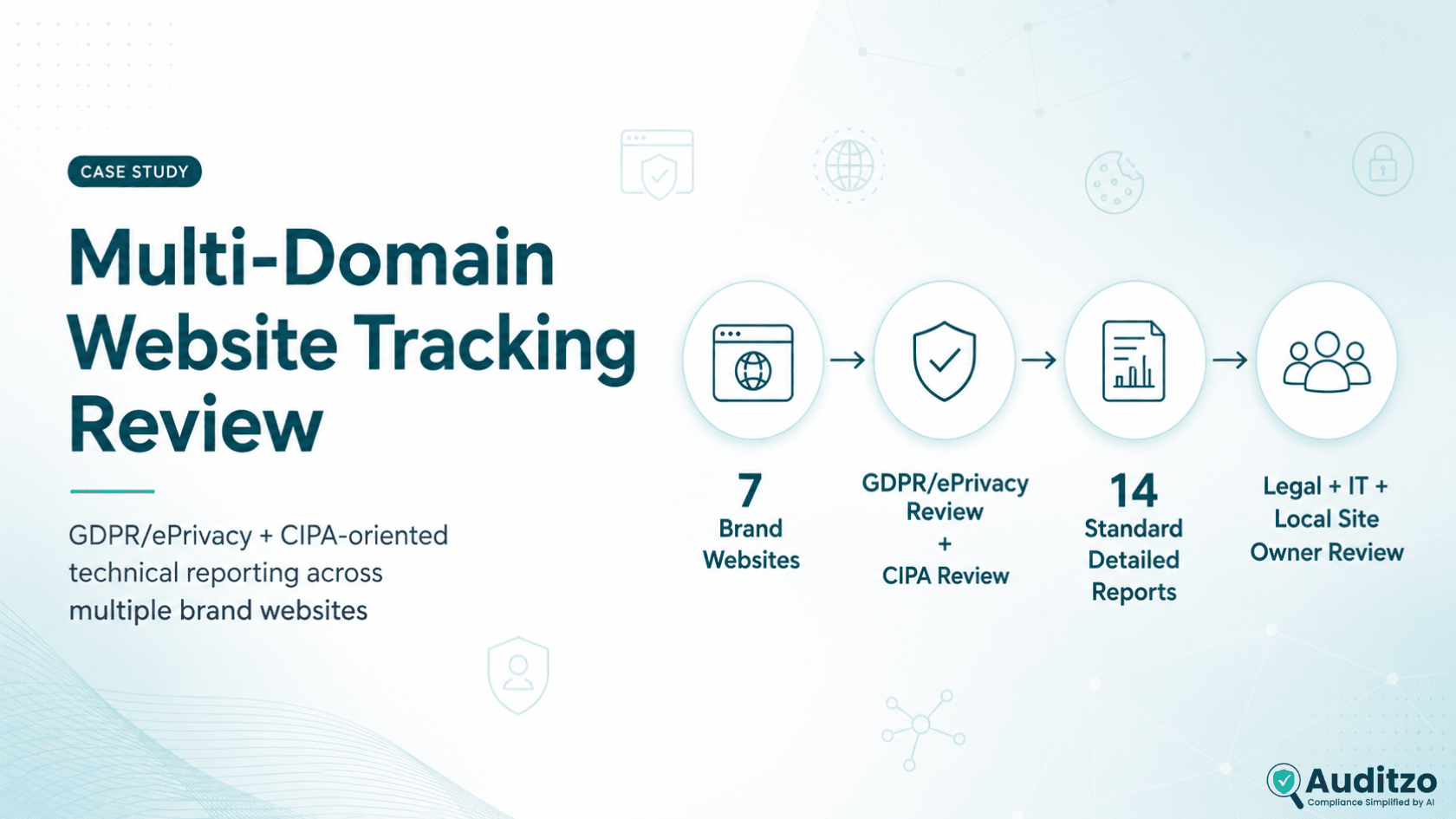
When a corporate legal team needed visibility into cookies, trackers, consent behavior, and third-party requests across seven brand websites, Auditzo helped create a structured technical baseline under both GDPR/ePrivacy and CIPA-oriented review paths. This case study shows how the reports supported Group IT and local site owners in deciding what needed follow-up.
Executive Summary
A global life sciences group needed a clear technical baseline across multiple brand websites before assigning follow-up work to internal IT and local site owners.
The corporate legal team wanted structured website tracking reports covering two review paths.
- GDPR/ePrivacy-oriented website tracking review
- CIPA-oriented technical tracking review
Auditzo delivered standard detailed reports across seven websites, covering cookies, trackers, third-party requests, consent behavior, and framework-oriented technical observations.
For most domains, the reports were produced through Auditzo’s standard website scan workflow. For two domains where automated access was limited, Auditzo completed the review using manual browser-based evidence capture from relevant regional test environments.
The result was a practical reporting package the client could use for internal legal, IT, and website-owner review.
Who this case study is for
This case study is relevant for corporate legal teams, privacy and compliance teams, Group IT teams, agencies, law firms, and businesses that manage multiple websites, brands, regions, or local site owners.
- Corporate legal teams managing multiple brand websites
- Privacy and compliance teams reviewing cookie and tracker behavior
- Group IT teams responsible for website governance
- Agencies managing privacy-related implementation work for clients
- Law firms supporting clients with website tracking evidence
- Businesses that need a first technical baseline before a deeper manual audit
If your organization manages several websites, brands, regions, or business units, a single-domain scan may not be enough. A structured website privacy audit can help your team understand what each website appears to do during real user visits.
The buyer problem
The client was not simply asking whether the websites used cookies. They needed a broader technical view of website tracking behavior across several brand websites.
- What tracking technologies are active across multiple websites?
- Which third-party services are being contacted?
- What cookies and browser storage signals are visible?
- How does consent-related behavior appear during review?
- Which sites may need follow-up from Group IT or local website owners?
- Which domains may require deeper review later?
- Can the findings be reviewed under both EU-oriented and California-oriented privacy concerns?
The client needed something more useful than a basic scanner result, but they were not yet asking for a full manual forensic audit.
That made a standard detailed Auditzo report the right first step.
Why standard detailed reports were the right starting point
For multi-domain organizations, the first problem is often visibility.
Before a legal, privacy, or IT team can decide whether deeper review or remediation is needed, they need a clear baseline of technical website behavior.
A standard detailed report can help answer practical questions such as these.
- Which trackers are active?
- Which third-party requests appear during review?
- What cookies are detected?
- Are consent-related patterns visible?
- Which domains may need more attention?
- Which findings should be assigned to local site owners or technical teams?
Auditzo’s Detailed Evidence Report is designed for this type of first-step review. It gives teams a structured technical report without immediately requiring a full manual evidence audit.
For cases where deeper evidence is needed later, Auditzo can support a Manual Evidence Audit with more detailed browser-based evidence, screenshots, HAR/network records, consent-state comparison, and manually reviewed observations.
Project scope
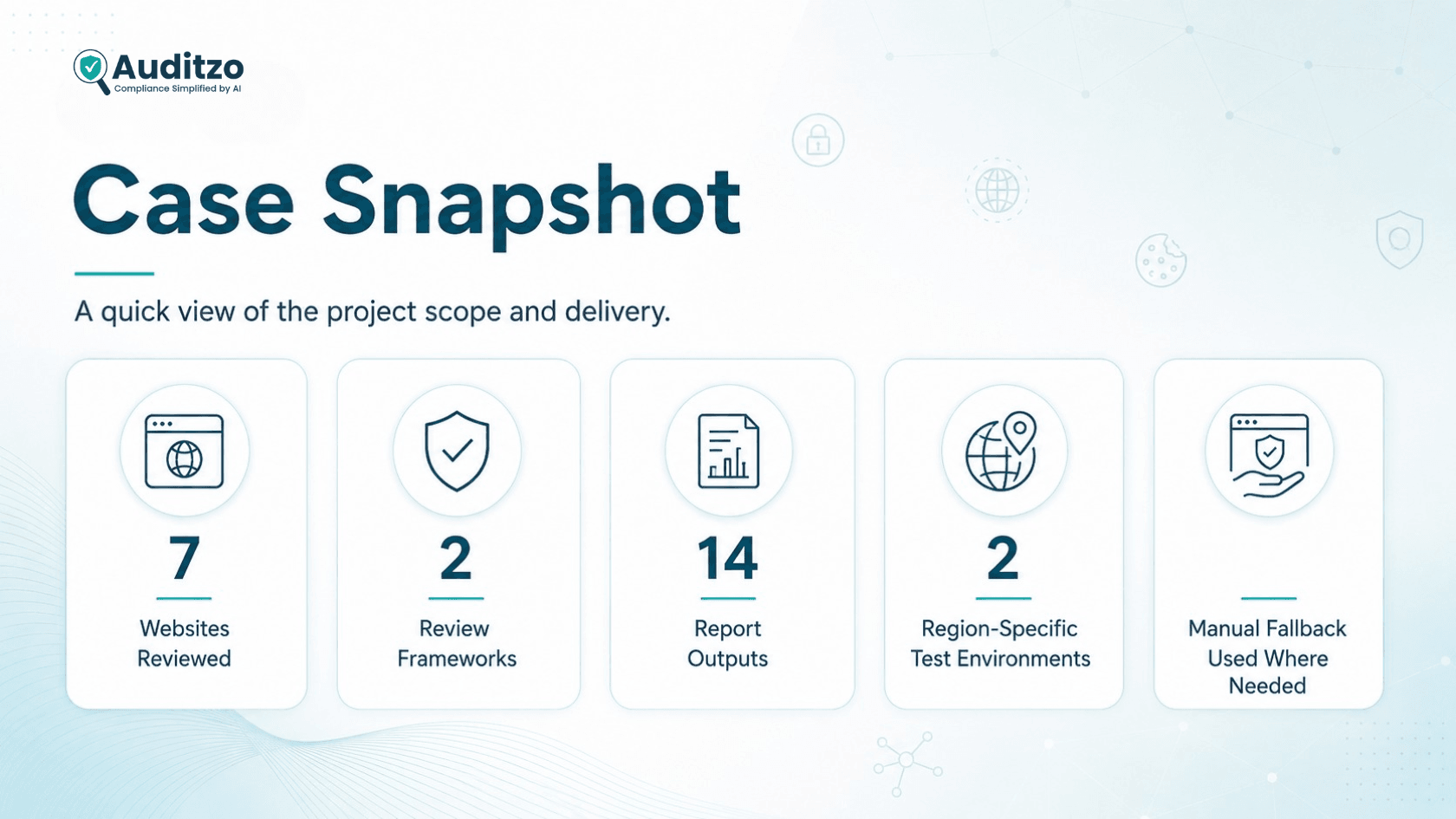
The client requested reports for seven brand websites.
Each website was reviewed under two framework-oriented paths.
- GDPR/ePrivacy-oriented website tracking review
- CIPA-oriented technical tracking review
In total, the project included seven websites, two framework-oriented reviews per website, fourteen standard detailed report outputs, region-aware review where needed, and manual browser-based fallback for restricted domains.
The reports focused on technical observations around website tracking behavior, including cookies, tracking scripts, third-party requests, consent-related behavior, browser-level signals, website-level privacy observations, and framework-oriented notes for internal review.
The reports were prepared as technical evidence and observations. They were not legal advice, legal conclusions, or legal compliance certification.
Review frameworks covered
GDPR/ePrivacy-oriented review
The GDPR/ePrivacy-oriented review focused on website tracking and consent-related behavior that may be relevant for EU privacy review.
This included technical observations around cookies, trackers, consent behavior, and third-party website activity.
Organizations reviewing EU-facing websites can also use Auditzo’s GDPR Website Audit, GDPR Audit Tool, or GDPR Cookie Checker depending on whether they need a broad audit, tool-assisted review, or cookie-focused visibility.
CIPA-oriented technical tracking review
The CIPA-oriented review focused on website tracking behavior and third-party communication patterns that may be relevant for internal California-oriented privacy review.
This included technical observations around third-party requests, tracking tools, consent-related signals, and website behavior that legal or privacy teams may want to review further.
For teams specifically reviewing California tracking concerns, Auditzo’s CIPA §638.51 Website Tracking Audit provides a more focused review path.
The execution challenge
Multi-domain reviews are rarely clean and uniform.
Different websites may use different CMS platforms, consent tools, analytics stacks, marketing pixels, regional scripts, tag managers, hosting setups, or access rules.
In this project, most domains could be reviewed through the standard Auditzo scan process.
However, two domains had limited automated access during execution. This is common in real-world website review work. Some websites restrict automated browsers, behave differently by region, redirect traffic, block crawler-like behavior, or load content inconsistently depending on environment.
Instead of skipping those domains or giving the client incomplete reports, Auditzo used manual browser-based evidence capture as a fallback.
This helped complete the review while keeping the output consistent with the agreed reporting scope.
Manual fallback for restricted domains
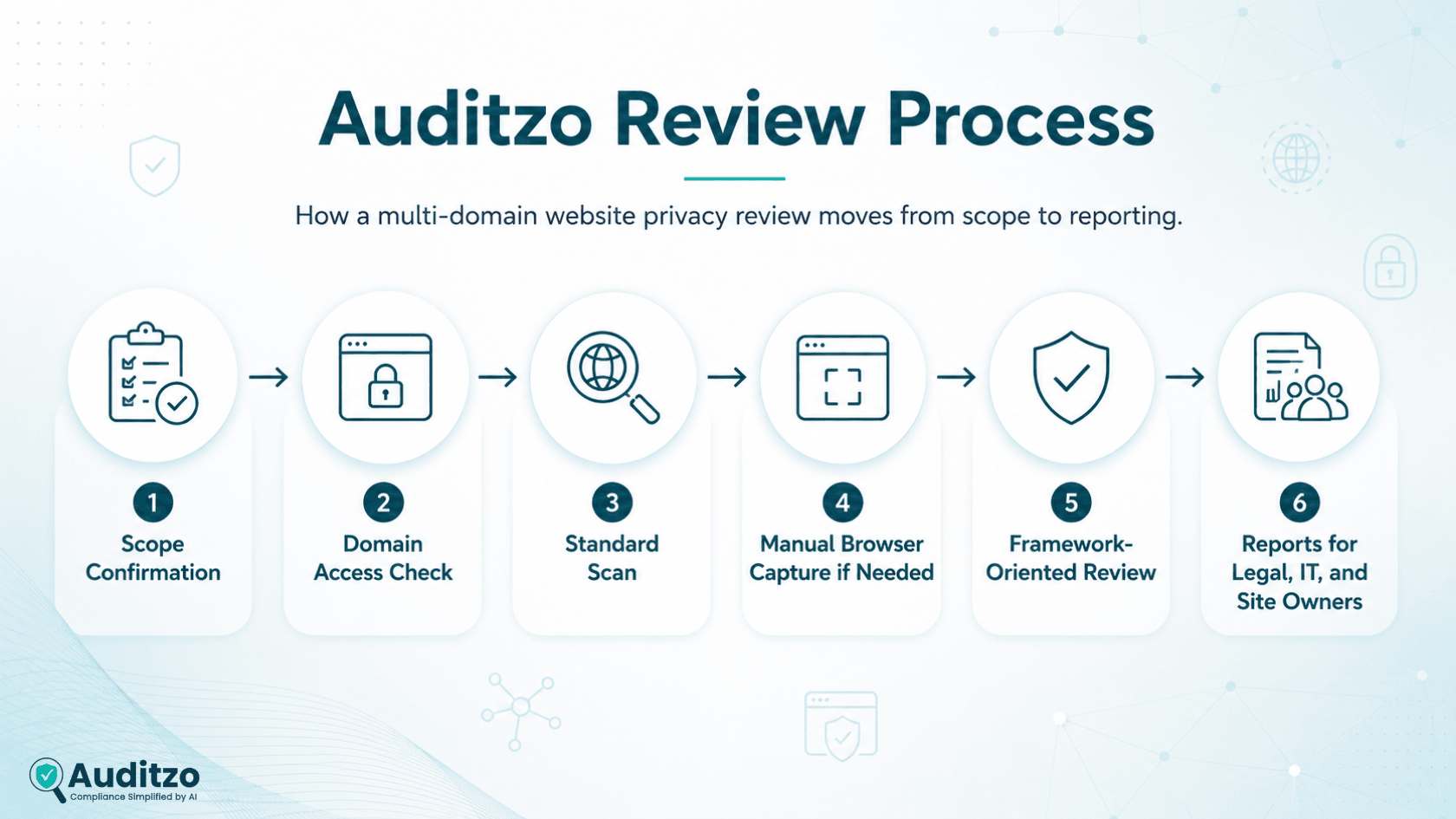
For the domains where automated access was limited, Auditzo completed the review using manual browser-based capture.
The review used region-specific environments to support the two framework paths.
- EU/Germany-oriented environment for GDPR/ePrivacy review
- California/US-oriented environment for CIPA-oriented technical review
This mattered because websites can behave differently depending on visitor location. Consent banners, cookies, trackers, third-party requests, and regional scripts may change based on geography.
Auditzo’s process allowed the project to continue without weakening the review quality or ignoring difficult domains.
This is one of the key differences between a basic automated scan and a practical technical review process. Automation is useful, but real-world privacy review also needs a fallback when automation is not enough.
What the client received
The client received a standard detailed reporting package across all seven websites.
The deliverables included these items.
- GDPR/ePrivacy-oriented reports for each domain
- CIPA-oriented technical tracking reports for each domain
- Website-level technical observations
- Cookie and tracker visibility
- Third-party request observations
- Consent-related website behavior notes
- Manual browser-based capture where automated access was limited
- Reports suitable for internal legal, IT, and local site-owner review
The reports gave the client a baseline for deciding what should happen next.
For some organizations, the next step may be internal review only. For others, it may lead to consent banner changes, tag cleanup, CMP configuration review, vendor review, deeper manual evidence capture, or ongoing monitoring.
Auditzo also provides Website Privacy Monitoring for teams that need recurring visibility into cookies, trackers, consent behavior, and third-party website changes over time.
How the reports supported internal review
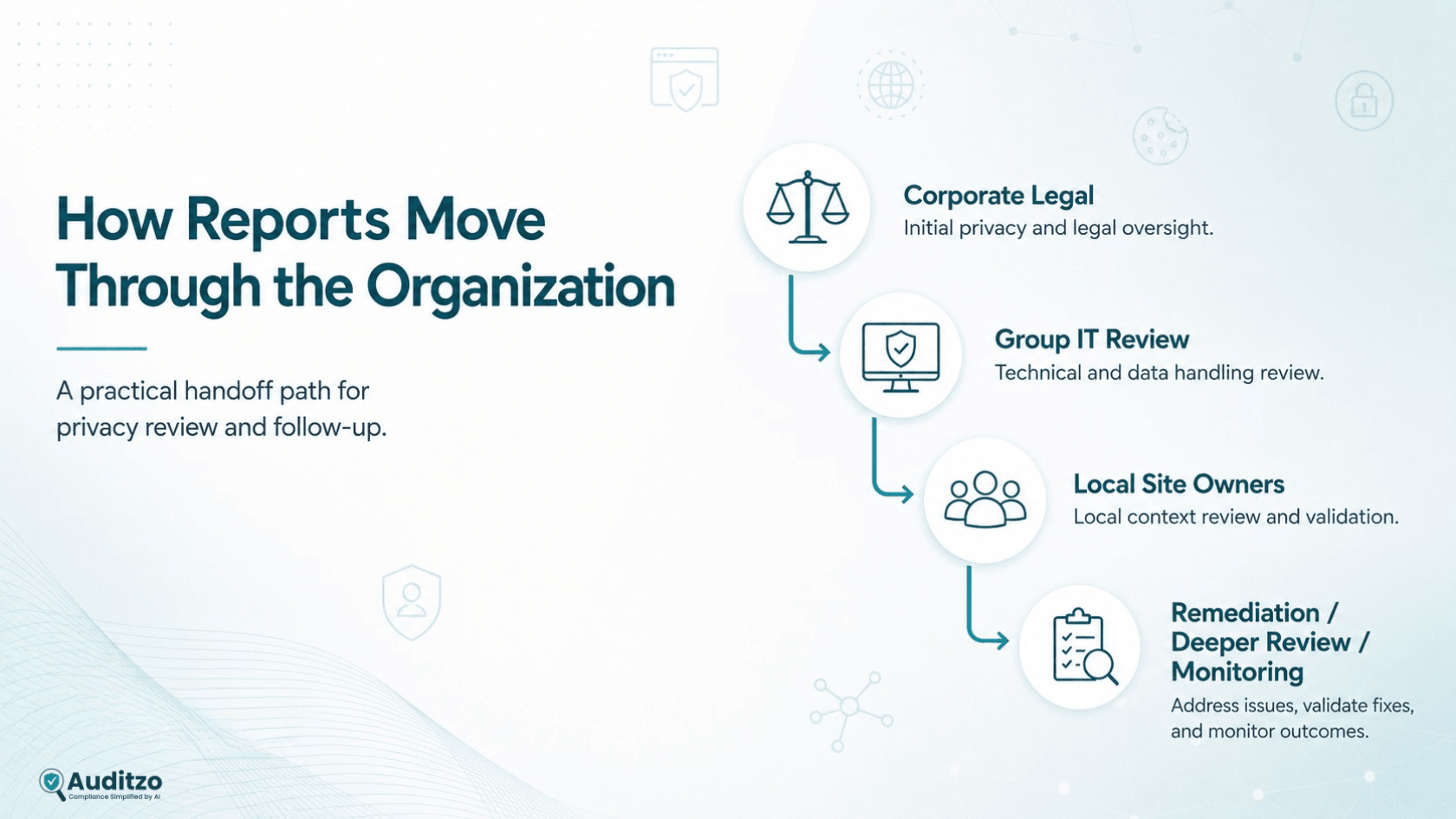
The reports were designed to support practical decision-making.
Corporate legal teams often do not need raw technical exports alone. Group IT teams do not need vague compliance claims. Local site owners need clear observations they can understand and assign.
The reporting package helped create a bridge between these stakeholders.
- The legal team could use the reports to understand the technical baseline.
- Group IT could review patterns across websites.
- Local site owners could follow up on domain-specific observations.
- Privacy or compliance teams could decide whether deeper review was needed.
This is where Auditzo’s role is strongest: turning observed website behavior into structured technical reporting that business, legal, privacy, and technical teams can actually use.
To understand the broader review approach, teams can also review How Auditzo Works.
Why this matters for multi-domain organizations
For a single website, a basic privacy scan may be enough to start a conversation.
For a multi-brand organization, the challenge is different.
Different domains may have different tracking tools, consent banners, third-party vendors, regional scripts, marketing teams, and local website owners. Even when websites belong to the same group, their technical privacy behavior may not be consistent.
This creates real governance questions.
- Are all brand websites using the same consent approach?
- Are some domains loading trackers differently?
- Are local site owners adding scripts without central review?
- Are third-party vendors consistent across the group?
- Which domains need deeper manual review?
- Which sites should be prioritized for remediation?
- Should monitoring be added after the first baseline?
A multi-domain technical review helps answer these questions before the organization commits to a larger remediation or legal review process.
When a standard detailed report is enough
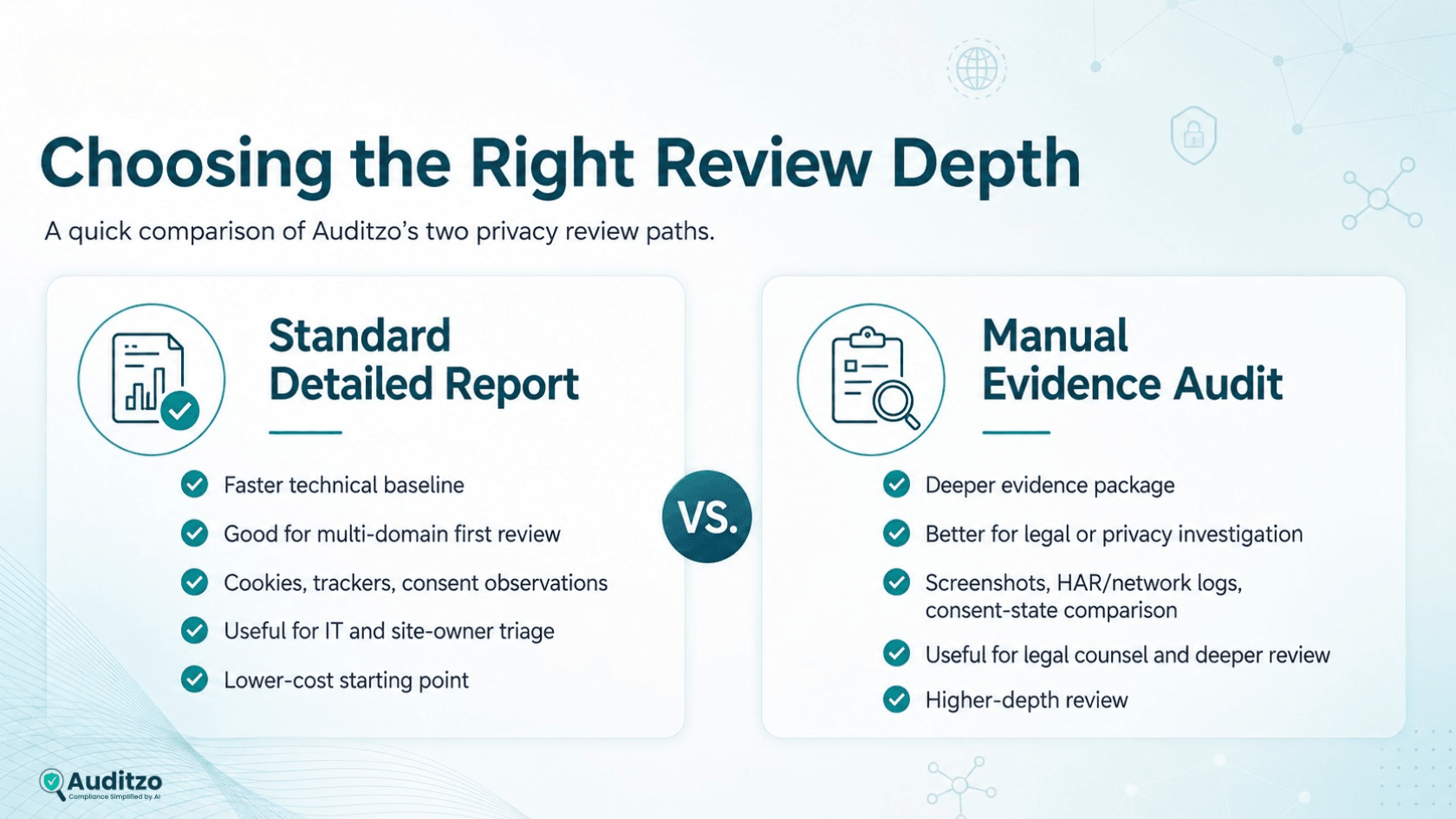
A standard detailed report is useful when the team needs a first structured baseline.
It is a good fit when these conditions apply.
- The organization has several websites to review
- The legal or privacy team needs initial technical visibility
- Group IT needs to understand website tracking behavior
- The team wants to decide which domains need deeper review
- The business needs a faster and more cost-effective first step
- The goal is internal review, triage, and next-step planning
For many teams, this is the right starting point before moving into a deeper evidence-backed audit.
When a deeper manual evidence audit may be better
A deeper manual evidence audit may be better when the team needs more detailed evidence documentation.
This may be appropriate when these conditions apply.
- Legal counsel needs more granular technical evidence
- The website uses complex consent states
- The team needs screenshots, HAR files, and consent-state comparison
- There are concerns around session replay, chat tools, pixels, or third-party request behavior
- The organization needs deeper documentation before remediation
- The team wants before-and-after verification after fixes
In those cases, Auditzo’s Manual Evidence Audit is a better fit than a standard report.
What this project showed
This project showed that Auditzo can support real-world corporate privacy review workflows, not just one-off website scans.
The review required multi-domain coordination, framework-specific reporting, GDPR/ePrivacy and CIPA-oriented review paths, manual fallback where automated access was limited, region-aware testing environments, and clear reporting for legal, IT, and local website stakeholders.
The project also reinforced an important point: website privacy review is not only about detecting cookies.
It is about understanding how a website behaves, what third parties are involved, what appears before or after consent, and what evidence internal teams need for next-step decisions.
Important note on legal scope
Auditzo provides technical evidence, website behavior observations, and framework-oriented reporting support.
Auditzo does not provide legal advice, legal opinions, legal compliance certification, or a final determination that a website is compliant or non-compliant with GDPR, ePrivacy, CIPA, CCPA/CPRA, or any other law.
The reports are designed to support review by internal teams, legal counsel, privacy teams, compliance teams, IT teams, agencies, and website owners.
Frequently asked questions
What is a multi-domain website tracking review?
A multi-domain website tracking review examines cookies, trackers, third-party requests, consent behavior, and website-level privacy observations across multiple websites or brand domains. It helps legal, privacy, IT, and website teams understand tracking behavior across a wider digital footprint.
What did Auditzo review in this case study?
Auditzo reviewed seven brand websites under two framework-oriented paths: GDPR/ePrivacy-oriented website tracking review and CIPA-oriented technical tracking review. The project produced fourteen standard detailed report outputs.
When is a standard detailed report useful?
A standard detailed report is useful when an organization needs a first technical baseline across one or more websites. It can help teams review cookies, trackers, consent-related behavior, third-party requests, and website-level observations before deciding whether deeper review or remediation is needed.
When should a manual evidence audit be considered?
A manual evidence audit may be better when legal, privacy, or IT teams need deeper technical documentation, such as screenshots, HAR or network logs, consent-state comparison, manual browser-based evidence capture, and more detailed observations for internal review.
Does Auditzo provide legal advice or compliance certification?
No. Auditzo provides technical evidence, website behavior observations, and framework-oriented reporting support. Auditzo does not provide legal advice, legal opinions, legal compliance certification, or a final legal determination that a website is compliant or non-compliant.
Need a similar multi-domain website tracking review?
If your organization manages multiple websites, brands, regions, or local site owners, Auditzo can help you create a structured technical baseline.
Auditzo can support these review needs.
- Standard detailed website tracking reports
- GDPR/ePrivacy-oriented website reviews
- CIPA-oriented technical tracking reviews
- Cookie and tracker visibility
- Manual evidence-backed audits
- Post-remediation verification
- Ongoing website privacy monitoring
- Multi-domain privacy review packages
You can start with a standard website privacy audit, compare options on the Auditzo pricing page, or contact Auditzo for a multi-domain quote.
Table of contents
- Executive Summary
- Who this case study is for
- The buyer problem
- Why standard detailed reports were the right starting point
- Project scope
- Review frameworks covered
- The execution challenge
- Manual fallback for restricted domains
- What the client received
- How the reports supported internal review
- Why this matters for multi-domain organizations
- When a standard detailed report is enough
- When a deeper manual evidence audit may be better
- What this project showed
- Important note on legal scope
- Frequently asked questions
- Need a similar multi-domain website tracking review?