How an Ecommerce Brand Reviewed Pre-Consent Tracking and Rebuilt Its Website Consent Controls
An ecommerce business serving customers across European and United States markets needed a clearer understanding of how analytics, advertising, behavioral tools, cookies, and third-party requests behaved before and after visitors interacted with its consent banner.
Auditzo conducted a technical website tracking and consent-behavior review covering representative ecommerce pages, initial page-load activity, consent-state differences, tag-management configuration, and selected remediation priorities.
The engagement gave the development, marketing, privacy, and legal review teams a shared technical record of what was observed, where implementation inconsistencies appeared, and which controls required further investigation or remediation.
Case-study note: This case study has been anonymized. Client-identifying details and sensitive technical information have been withheld. Auditzo documents observable website behavior and provides evidence-focused findings for technical, privacy, and legal review. Auditzo does not provide legal advice, determine legal violations, certify compliance, or guarantee business outcomes.
Case Study at a Glance
- Organization: Anonymized ecommerce brand
- Industry: Fashion and lifestyle ecommerce
- Visitor contexts: European and selected United States website journeys
- Pages reviewed: Representative landing, product, cart, and other agreed public pages
- Technical focus: Cookies, pixels, browser storage, third-party requests, consent-state behavior, and tag-management configuration
- Teams involved: Development, marketing, privacy, and legal review stakeholders
- Auditzo output: Technical findings, supporting evidence references, remediation guidance, and selected follow-up verification
This engagement required more than identifying whether a cookie banner was present. The client needed to determine whether the underlying scripts, cookies, browser storage, and third-party requests behaved consistently with the intended visitor choices.
Organizations with similar ecommerce concerns can review Auditzo's cookie consent audit for ecommerce websites and the deeper Manual Evidence Audit.
The Ecommerce Tracking Challenge
The organization depended on common ecommerce technologies for audience measurement, advertising attribution, conversion reporting, user-experience analysis, and campaign optimization.
Its website environment included technologies associated with:
- Web analytics
- Advertising and conversion measurement
- Social-media pixels
- Behavioral analytics
- Session-replay functionality
- Tag management
- Consent management
- Ecommerce and marketing integrations
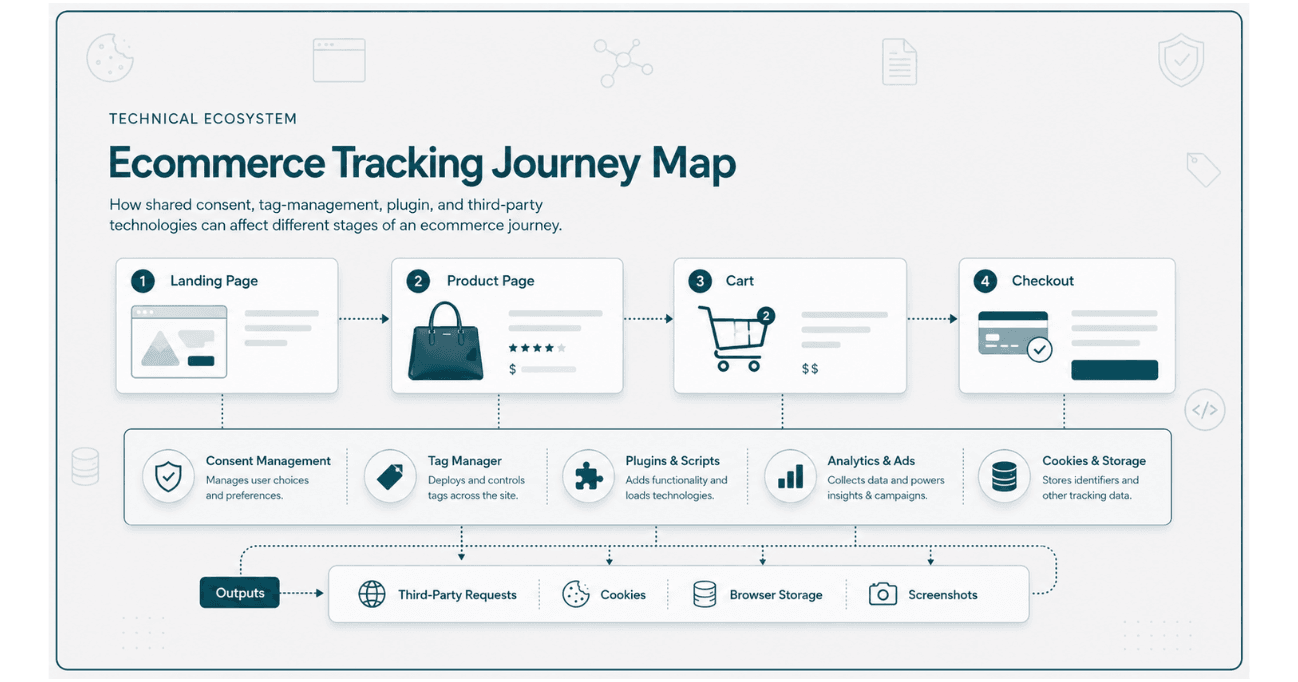
These technologies are widely used and should not be treated as automatically unlawful merely because they appear on a website.
The technical concern was whether the organization could reliably answer questions such as:
- Which technologies appeared during the initial page load?
- Which cookies and browser-storage entries were created?
- Which third-party destinations received browser requests?
- Did the website behave differently after Reject and Accept choices?
- Were scripts controlled through the intended consent workflow?
- Did directly embedded scripts bypass tag-manager controls?
- Were the same rules applied across different pages and browsers?
- Could each technology be linked to a clear internal owner and business purpose?
The website displayed a consent interface, but the client needed evidence showing whether the interface and the underlying technical behavior were working together as intended.
Why the Consent Banner Was Not Enough
A visible cookie or consent banner does not automatically establish that all related scripts and requests are technically controlled.
Implementation can become inconsistent when:
- Some tags are managed through a central container
- Other scripts are embedded directly in website templates
- Plugins load their own third-party resources
- Campaign tools introduce new pixels
- Consent states are not available when tags first initialize
- Legacy triggers remain active after vendors or campaigns change
- Different pages use different template or plugin configurations
This separation between the visible banner and the underlying website behavior was central to the review.
The objective was not to assign a legal label to every request. It was to document the observed sequence and give the client and its advisers enough technical context to decide what required correction, further investigation, or legal analysis.
Auditzo's broader approach is explained in its website audit methodology.
Audit Scope and Technical Method
The engagement was structured around representative ecommerce journeys and observable browser behavior.
1. Initial Page-Load Review
Auditzo reviewed what appeared during the initial browser observation period before relying on a visitor's consent interaction.
The initial-state review considered:
- Cookies visible to the browser
- Local and session storage indicators
- Third-party request destinations
- Analytics and advertising technologies
- Session or behavioral tools
- Tag-manager initialization
- Consent-platform initialization
- Request timing and sequence
This established a technical baseline for the reviewed page and browser session.
2. Consent-State Comparison
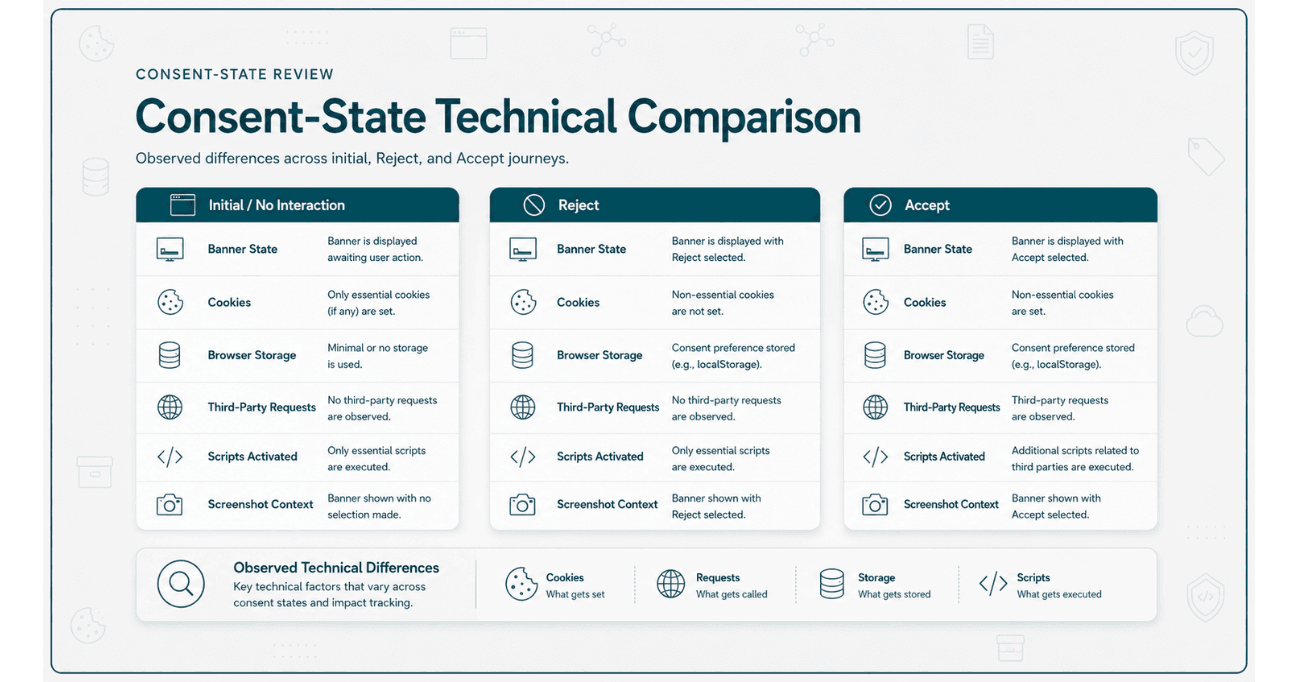
Where supported by the website journey and agreed scope, separate sessions were used to compare:
- Initial or no-interaction state
- Reject journey
- Accept journey
The comparison focused on observable changes in:
- Cookies
- Browser storage
- Third-party requests
- Script activation
- Visible banner state
- Page behavior
Consent-state testing documents whether visitor choices produce different technical outcomes. It does not independently determine whether those outcomes satisfy every applicable legal requirement.
3. Network and Request Review
Auditzo reviewed browser-network and HAR-based observations to understand which selected third-party destinations appeared during the test journeys and when those requests occurred.
Relevant evidence could include:
- Request hostname
- Request URL and timing
- Page and referrer context
- Observable query-string fields
- Cookie or identifier references
- Redirect behavior
- Associated technology or vendor category
A request was reviewed within its page, timing, technology, and consent-state context rather than being treated as a legal conclusion by itself.
4. Tag Manager and Script-Control Review
The review considered how scripts were introduced and whether they appeared to follow the intended technical control path.
Auditzo looked for patterns such as:
- Tags firing on broad page-load triggers
- Consent conditions missing from selected triggers
- Directly embedded scripts outside the central tag container
- Plugin-generated third-party resources
- Duplicate tags
- Legacy campaign integrations
- Different configurations across representative pages
5. Cross-Page Comparison
Representative landing, product, cart, or other agreed pages were compared to identify whether technologies and consent behavior remained consistent across the ecommerce journey.
This helped distinguish between:
- A page-specific implementation pattern
- A shared template issue
- A campaign-specific integration
- A plugin or platform-level behavior
- A legacy tag requiring ownership review
Review Auditzo's audit scope and limitations for an explanation of what automated and manual reviews can and cannot establish.
Technical Patterns Documented
The review identified several implementation patterns requiring development, marketing, privacy, or legal-team attention.
Selected technologies appeared during the initial page lifecycle
Analytics, advertising, behavioral, or other third-party technologies were observed during selected initial-state journeys.
The technical finding helped the client investigate:
- Why each technology was present
- Which team or vendor controlled it
- Whether the timing matched the intended design
- Whether further consent-state testing was required
- Whether disclosures and user controls required legal review
Consent choices did not always produce clearly consistent behavior
Differences between initial, Reject, and Accept journeys required further review across selected cookies, requests, storage entries, or scripts.
The objective was to determine whether the website's technical response matched the intended consent implementation—not to label every difference as a confirmed legal breach.
Not every script followed the same control path
Some technologies were managed through the primary tag-management setup, while others could be introduced through templates, plugins, custom code, or campaign-specific integrations.
This created a risk that the visible banner and the underlying script behavior would not always remain synchronized.
Legacy and duplicate configurations complicated ownership
Selected tags or integrations required internal ownership review because the current team could not immediately confirm:
- The current business purpose
- The responsible internal owner
- The original implementation source
- The pages where the technology was expected
- Whether the technology remained necessary
Page-level differences made one-session testing insufficient
The presence or behavior of a technology could vary between landing, product, cart, and other ecommerce pages.
This reinforced the need for representative journey testing rather than relying on a single homepage scan.
Evidence Delivered to the Client Team
Auditzo organized the findings so technical and non-technical stakeholders could work from the same underlying record.

Scope and Environment Summary
- Reviewed pages and journeys
- Browser and observation environment
- Regional context where applicable
- Consent states reviewed
- Known exclusions and limitations
Technology and Request Inventory
- Observed technology ecosystems
- Associated third-party hostnames
- Technology categories
- Pages where selected technologies appeared
- Initial timing observations
Consent-State Comparison
- Initial-state cookies and storage
- Reject-state observations
- Accept-state observations
- Request and script differences
- Visible banner context
Technical Findings Register
- Observed behavior
- Affected page or journey
- Supporting evidence reference
- Technical context
- Suggested owner team
- Recommended remediation or investigation step
Evidence References
- Timestamped screenshots where included
- HAR and network observations
- Cookie and storage comparisons
- Request-level examples
- Consent-state notes
- Evidence traceability information
The exact contents of a Manual Evidence Audit depend on the agreed scope. Screenshots, HAR files, storage comparisons, and other supporting artifacts are not automatically identical across every engagement.
Legal teams needing counsel-directed technical support can review Auditzo's website privacy evidence support for law firms.
Remediation Priorities
The remediation plan focused on making website behavior easier to control, understand, test, and maintain.
1. Create an authoritative tracking inventory
The client needed one maintained record of:
- Each script, tag, pixel, and vendor
- Its business purpose
- Its internal owner
- The pages where it was expected
- Its technical control path
- The person or team authorized to change it
2. Review consent-platform initialization
The team needed to confirm that the intended consent state was available at the correct point in the website lifecycle and before controlled technologies relied on it.
3. Review tag-manager triggers
Selected triggers were reviewed for:
- Page-load conditions
- Consent dependencies
- Exceptions
- Duplicate activation
- Legacy campaign logic
- Differences between page templates
4. Identify scripts outside the main tag container
Plugins, direct template code, ecommerce integrations, and custom HTML required separate review because they might not follow the same controls as centrally managed tags.
5. Remove or disable obsolete technologies
Technologies without a confirmed current owner or business purpose became candidates for removal, disablement, or additional review.
6. Align technical implementation with approved disclosures
The technical inventory gave the client's privacy and legal reviewers a clearer factual basis for evaluating website disclosures, user controls, vendor descriptions, and applicable rights.
Auditzo did not provide final legal-policy language or approve the legal sufficiency of those disclosures.
7. Define a verification plan
Selected pages and consent journeys were identified for follow-up review after implementation changes.
Auditzo can support this stage through website tracking remediation support, including tag review, consent-configuration support, developer handoff, and selected retesting.
Post-Change Verification
After the client's implementation team completed selected changes, follow-up testing could compare the updated behavior against the original observations.
Verification focused on questions such as:
- Did selected technologies still appear during the initial state?
- Did Reject and Accept choices produce the expected technical differences?
- Were duplicate or obsolete tags removed?
- Were selected scripts moved into the intended control path?
- Did representative pages behave consistently?
- Did any new or unexpected requests appear?
Post-change verification records the behavior observed during the agreed retest. It is not a certification that every page, browser, user, campaign, or future website version will behave identically.
What Changed for the Organization
The strongest outcome was not a legal-compliance badge or a marketing percentage. It was better technical visibility and clearer ownership of the website tracking environment.
The engagement gave the organization:
- A clearer inventory of observed technologies and request destinations
- Evidence showing how representative ecommerce journeys behaved
- A comparison of selected consent states
- A structured way to assign findings to development, marketing, privacy, or vendor teams
- A remediation plan focused on consent sequencing, tag triggers, plugins, and legacy integrations
- A repeatable method for checking selected changes after implementation
The process also helped development and privacy stakeholders discuss the same technical facts without relying solely on banner appearance, policy wording, or plugin configuration screens.
No claim is made that the engagement produced a specific increase in opt-ins, conversions, trust scores, revenue, or avoided penalties because supporting evidence for those outcomes is not included in this case study.
Ongoing Governance and Monitoring
Ecommerce tracking environments change frequently.
New behavior can be introduced through:
- Marketing campaigns
- New advertising pixels
- Tag-manager publications
- Plugin updates
- Platform integrations
- A/B testing tools
- Agency changes
- Theme or checkout updates
Useful long-term controls may include:
- Named owners for each tracking technology
- Approval requirements for new tags
- Documented consent-category mapping
- Pre-production testing for significant changes
- Periodic automated visibility checks
- Targeted manual reviews after material releases
- Escalation to privacy or legal advisers where appropriate
Auditzo's Website Privacy Monitoring can provide recurring visibility into changes in cookies, trackers, and third-party requests.
Monitoring is a technical visibility service. It does not guarantee compliance, prevent all regressions, or eliminate legal or operational risk.
Legal and Scope Boundaries
This engagement documented observable website behavior. It did not determine whether the organization violated GDPR, ePrivacy requirements, the CCPA/CPRA, CIPA, or any other law.
GDPR and ePrivacy-oriented review
Technical evidence can help privacy and legal teams evaluate cookies, tracking technologies, consent mechanisms, purposes, disclosures, and visitor choices.
The legal treatment depends on the technology, purpose, data processing, jurisdiction, visitor context, and other facts that require qualified legal analysis.
California privacy review
Technical evidence may help advisers evaluate website tracking, disclosures, opt-out mechanisms, and potential sale or sharing questions.
Auditzo does not decide whether an observed activity legally constitutes a sale, sharing, violation, or regulated disclosure.
Evidence and legal proceedings
Auditzo can provide structured technical documentation, screenshots, network observations, timestamps, hashes, and supporting evidence references where included in the agreed scope.
Auditzo does not guarantee that any report or artifact will be admissible in a legal proceeding. Authentication, admissibility, privilege, and evidentiary use remain matters for qualified counsel and the relevant authority or court.
Review the Auditzo audit scope and limitations before relying on any automated or manual report.
Who This Type of Review Is For
An ecommerce cookie consent and tracking review may be useful for:
- Online retailers using multiple advertising and analytics platforms
- Shopify, WooCommerce, Magento, or custom ecommerce websites
- Marketing teams managing pixels and campaign tags
- Privacy teams needing evidence beyond policy review
- Developers troubleshooting CMP and GTM behavior
- Legal teams reviewing website tracking questions
- Organizations responding to demand letters or internal risk reviews
- Businesses planning remediation or recurring monitoring
Teams needing an initial automated view can compare Auditzo's website privacy audit options.
Frequently Asked Questions
Does a visible cookie banner mean an ecommerce website is technically controlling all trackers?
No. A banner may be visible while selected scripts, plugins, tags, or third-party requests operate through separate technical paths. Testing is needed to observe whether visitor choices produce the intended changes.
Did Auditzo confirm that the website violated GDPR or the CCPA?
No. Auditzo documented observable technical behavior and provided evidence and remediation-oriented findings. Qualified legal advisers determine whether those facts have legal significance.
Does the presence of a pixel or analytics tool automatically mean the website is unlawful?
No. The presence of a technology alone does not establish a legal violation. Its treatment depends on its purpose, configuration, data flow, visitor controls, disclosures, jurisdiction, and other facts.
Why review product and cart pages instead of only the homepage?
Ecommerce pages can load different plugins, scripts, marketing integrations, and conversion technologies. A homepage-only scan may not represent behavior across product, cart, checkout, or campaign journeys.
Why compare Initial, Reject, and Accept states?
Consent-state comparison helps document whether cookies, storage, scripts, and third-party requests behave differently before interaction and after a visitor makes a choice.
Can an automated scan replace a Manual Evidence Audit?
No. Automated scans provide useful initial visibility. Manual audits are more appropriate when multiple pages, consent interaction, human validation, screenshots, request-level analysis, or deeper evidence documentation is required.
Does every Manual Evidence Audit include raw HAR and evidence files?
Manual Evidence Audit deliverables depend on the agreed scope. HAR files, screenshots, cookie and storage comparisons, and other supporting evidence may be included where expressly agreed.
Can Auditzo help fix the implementation?
Yes. Remediation support can be scoped separately and may include tag-manager review, consent-platform configuration support, script cleanup, developer guidance, and selected post-change verification.
Can Auditzo guarantee that tracking issues will never return?
No. Ecommerce websites change through campaigns, platform updates, plugins, tags, and integrations. Monitoring and change controls can improve visibility but cannot guarantee that future issues will never occur.
What Auditzo Delivered
- Representative ecommerce page and journey review
- Initial-state technical observations
- Applicable Reject and Accept consent-state comparisons
- Cookie, browser-storage, and third-party request review
- Tag-manager and script-control observations
- Technology and request inventory
- Evidence-backed technical findings register
- Developer-focused remediation priorities
- Selected follow-up verification workflow
- Clear technical, legal, and scope limitations
The exact deliverables for future projects depend on the selected audit type, website architecture, pages, regions, consent journeys, technical questions, and agreed supporting evidence.
Need a Clearer View of Your Ecommerce Tracking?
Start with an automated audit when you need an initial view of cookies, trackers, and third-party activity.
Choose a Manual Evidence Audit when you need multiple-page testing, Initial, Reject, and Accept comparisons, screenshots, request-level analysis, human-reviewed findings, or supporting evidence files according to an agreed scope.
Run an initial website audit or discuss a Manual Evidence Audit.
Ecommerce teams can also explore Auditzo's dedicated cookie consent audit service for ecommerce websites.
Auditzo provides technical observations, evidence-focused documentation, remediation support, and monitoring. Auditzo does not provide legal advice, certify compliance, confirm legal violations, calculate legal penalties, or guarantee future website behavior or commercial results.
Table of Contents
- Case Study at a Glance
- The Ecommerce Tracking Challenge
- Why the Consent Banner Was Not Enough
- Audit Scope and Technical Method
- Technical Patterns Documented
- Evidence Delivered to the Client Team
- Remediation Priorities
- Post-Change Verification
- What Changed for the Organization
- Ongoing Governance and Monitoring
- Legal and Scope Boundaries
- Who This Type of Review Is For
- Frequently Asked Questions
- What Auditzo Delivered
- Next Steps