How Auditzo Helped a Shopify Beauty Brand Review Cookie Consent Behavior Across Accept and Decline Journeys
A technical evidence case study showing why ecommerce cookie consent audits should go beyond the homepage and review real visitor journeys across pre-consent, Accept, Decline, cart, checkout, browser storage, and HAR/network evidence.
At a glance
- Client type: Shopify ecommerce beauty brand
- Audit type: Manual cookie consent evidence audit
- Primary concern: Cookie behavior across Accept and Decline states
- Journey reviewed: Homepage, product page, cart, and checkout before payment
- Evidence captured: Cookies, screenshots, HAR files, browser storage, timeline, findings register, and evidence manifest
- Output: Audit-ready technical evidence package for privacy, legal, marketing, ecommerce, and engineering review
Need to understand what your ecommerce site loads before consent, after Accept, and after Decline? Request a manual evidence audit from Auditzo or request a sample evidence report.
Need a broader Shopify review that also covers storefront tracking, consent behavior, accessibility, remediation and verification? Explore Auditzo's Shopify privacy and accessibility audit .
Need a broader Shopify-specific review of Customer Events, app or custom pixels, consent states, cookies and storefront tracking behavior? Explore Auditzo's Shopify Privacy & Consent Audit .
The Client Context
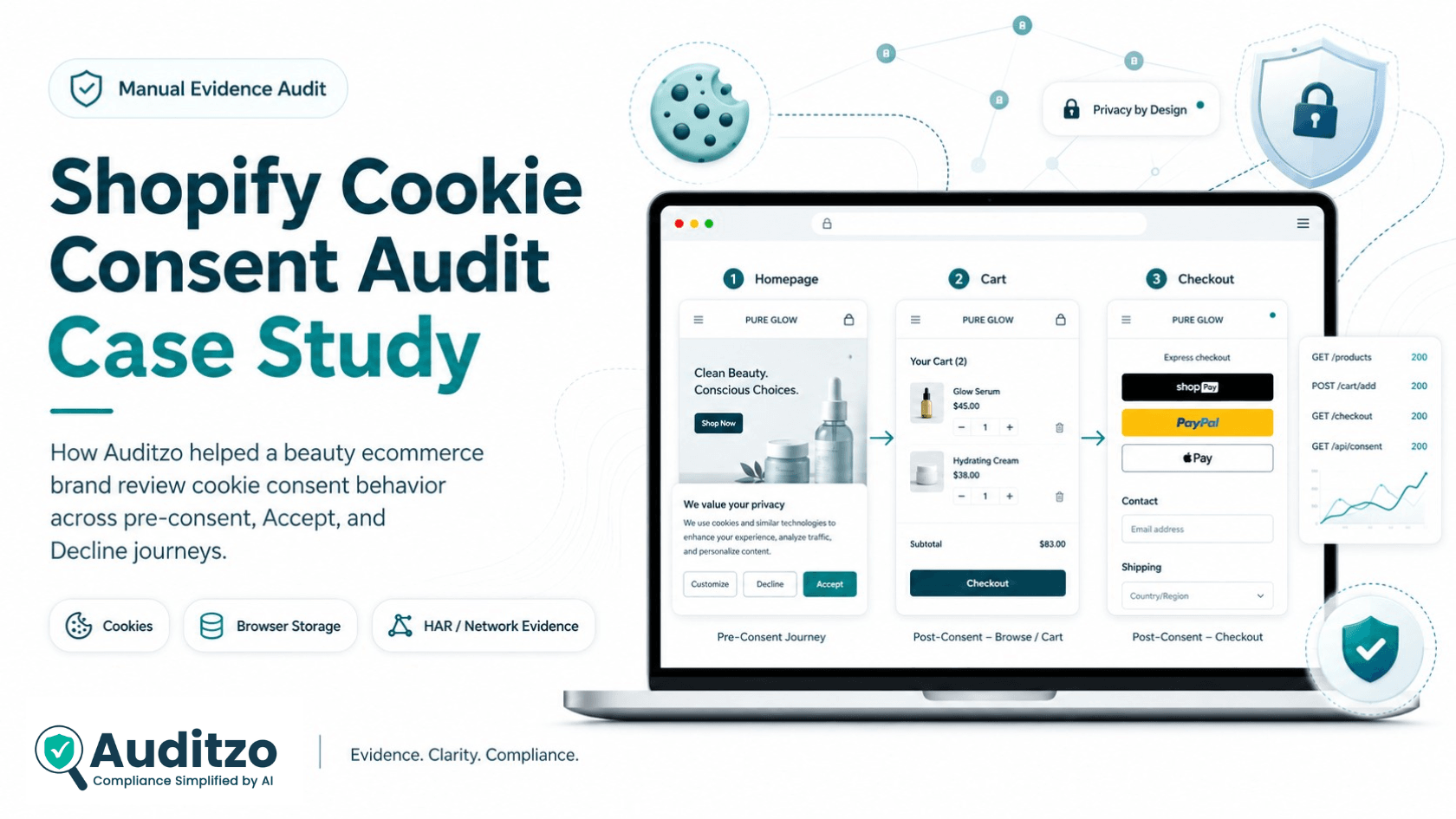
A Shopify-based ecommerce beauty brand approached Auditzo with a simple but important requirement. They wanted a clearer picture of how cookies behaved on their website.
Not just on the homepage. Not just after clicking Accept. And not just from a basic scanner report.
They wanted technical evidence their privacy, ecommerce, marketing, engineering, and legal teams could actually review.
Like many ecommerce brands, the website was not a simple storefront. It included a mix of systems that may support product browsing, cart behavior, checkout flow, payment options, analytics, marketing attribution, customer messaging, product reviews, advertising pixels, security, fraud prevention, and ecommerce operations.
That is normal for modern ecommerce. But it also creates a practical review problem. A homepage-only cookie scan may not show what happens deeper in the customer journey.
Who This Case Study Is For
This case study is useful for teams that need more than a basic cookie list and want technical evidence that can support internal review.
- Shopify and ecommerce teams reviewing cookie consent behavior across real visitor journeys
- Privacy and compliance teams preparing internal website tracking review
- Marketing operations teams managing tags, pixels, analytics, and attribution tools
- Engineering teams responsible for consent behavior, scripts, browser storage, and checkout implementation
- Law firms and legal teams needing technical evidence for website privacy or tracking review
For legal and privacy teams reviewing multiple client websites, Auditzo also provides privacy audits for law firms and legal teams.
The Challenge
The client wanted to understand cookie consent behavior across different visitor choices.
The core questions were practical:
- What happens before the visitor makes any cookie choice?
- What changes after the visitor clicks Accept?
- What remains after the visitor clicks Decline?
- Does the cookie footprint change between Accept and Decline?
- Does the ecommerce journey introduce additional cookies, storage values, or network activity?
- What happens at product page, cart, and checkout before payment?
- What evidence can internal teams review later?
A basic automated scan could answer part of this. But it would not provide enough journey context for a serious review.
For this audit, the client needed evidence, not just a cookie list.
Why a Homepage Scan Was Not Enough
A homepage-only cookie scan usually does not show the full picture.
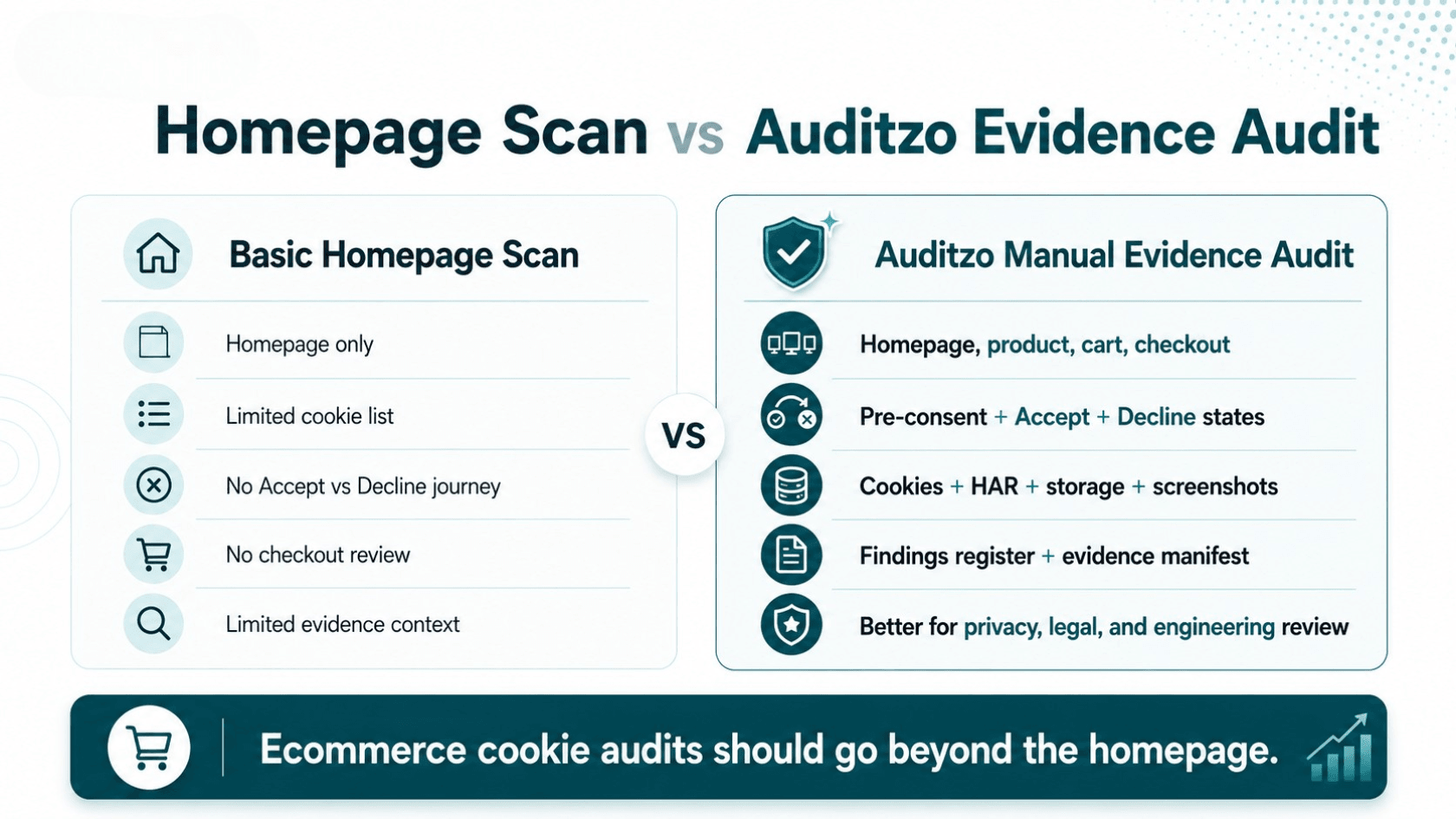
For ecommerce websites, cookie and tracking behavior is often journey-dependent. The homepage may load one set of scripts. A product page may load another set. The cart may trigger additional ecommerce logic. Checkout may bring in payment, fraud prevention, security, currency, tax, shipping, and platform infrastructure.
That means a visitor who only lands on the homepage is not the same as a visitor who views a product, adds it to cart, and reaches checkout.
This is why Auditzo structured the audit around a real ecommerce path instead of stopping at the first page load.
The reviewed path included homepage, product page, cart, and checkout before payment. No payment information was submitted and no order was placed.
For brands that need a deeper technical review, this is the difference between a quick scan and a manual evidence audit.
What Is a Shopify Cookie Consent Audit?
A Shopify cookie consent audit reviews how cookies, browser storage, scripts, and network requests behave before consent, after Accept, and after Decline.
For ecommerce websites, the review should include more than the homepage because cookie and vendor behavior may change on product pages, cart pages, and checkout before payment.
A strong cookie consent audit can help identify technical evidence for internal review, but it does not replace legal advice or guarantee legal compliance.
Audit Objective
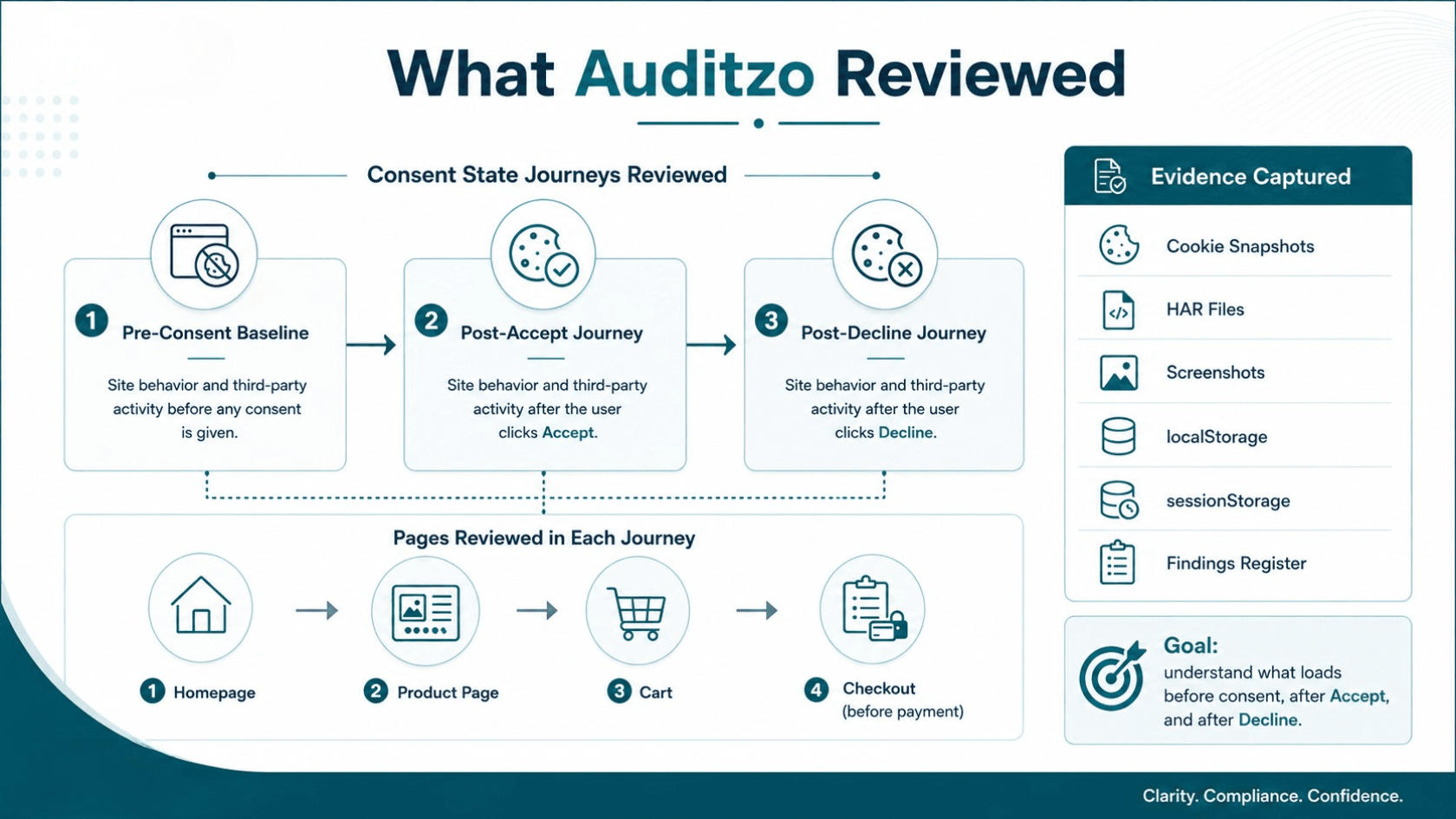
The audit objective was to create a structured evidence package showing how browser-visible cookies, browser storage, and network activity behaved across three consent states.
| Consent State | What It Means | Journey Reviewed |
|---|---|---|
| Pre-Consent Baseline | Before the visitor clicked Accept, Decline, or Manage Preferences | Homepage |
| Post-Accept Journey | After the visitor clicked Accept | Homepage, product page, cart, checkout before payment |
| Post-Decline Journey | After the visitor clicked Decline | Homepage, product page, cart, checkout before payment |
The audit was designed to help the client answer one practical question: what actually happens in the browser when a visitor accepts or declines cookies?
Auditzo’s Approach
Auditzo used controlled manual browser testing instead of relying only on automated scanner output.
Each consent state was captured separately using a fresh browser session. The evidence collection included consent banner screenshots, homepage screenshots, product page screenshots, cart screenshots, checkout screenshots, browser cookie snapshots, exported cookie CSV files, HAR/network captures, localStorage screenshots, sessionStorage screenshots, timestamped session notes, comparison workbooks, a findings register, and an evidence manifest.
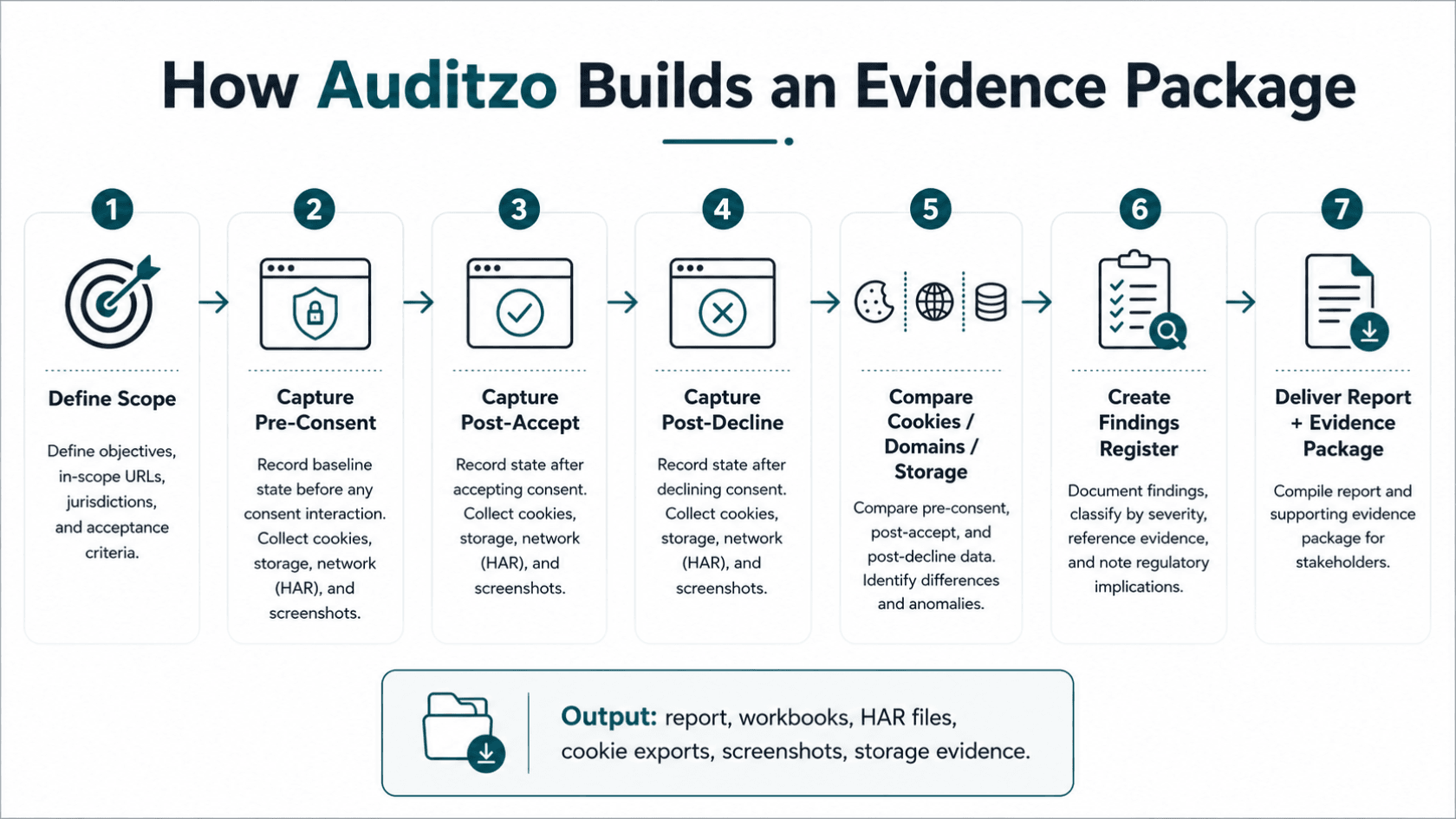
This gave the client both a human-readable report and a technical evidence package their teams could review later.
Important: Auditzo provides technical evidence and compliance-oriented observations. Auditzo does not provide legal advice, legal opinions, or compliance certification.
Consent Journeys Tested
Pre-Consent Baseline
This session captured the homepage before the visitor made any cookie choice. The goal was to understand what was visible before Accept, Decline, or Manage Preferences was selected.
Post-Accept Journey
This session captured the ecommerce path after the visitor clicked Accept. The reviewed journey included homepage, product page, cart, and checkout before payment.
This helped show what expanded after the visitor gave consent.
Post-Decline Journey
This session captured the same ecommerce path after the visitor clicked Decline. The reviewed journey again included homepage, product page, cart, and checkout before payment.
This helped show what remained after the visitor rejected cookies.
What Auditzo Delivered
Auditzo delivered a complete evidence package, not just a summary report.
| Deliverable | Purpose |
|---|---|
| Final PDF report | Executive summary, methodology, findings, review priorities, limitations, and final conclusion |
| Cookie comparison workbook | Normalized cookie comparison across consent states and journey steps |
| Third-party domain workbook | HAR/domain-level review across consent states |
| Evidence manifest | File navigation index for raw evidence |
| Timeline workbook | Capture windows and timestamp mapping |
| Findings register | Technical findings, evidence references, and recommended actions |
| Raw screenshots | Visual evidence of banner states, page states, checkout, cookies, storage, and network logs |
| HAR files | Browser network captures |
| Cookie CSV exports | Browser-visible cookie snapshots |
| Browser storage screenshots | localStorage and sessionStorage evidence |
| Evidence README | Plain-English guide for reviewing the package |
This structure made the audit useful for multiple stakeholders. Leadership could read the report. Technical teams could inspect the evidence. Privacy and compliance teams could review findings. Legal counsel could use the evidence as a starting point for legal interpretation.
Want to see how an Auditzo evidence package is structured? Request a sample evidence report.
Key Technical Observations
The audit showed that the website’s cookie behavior changed between Accept and Decline states.
After Accept, the cookie and network footprint expanded across the ecommerce journey.
After Decline, the cookie footprint reduced compared with Accept. That was a positive technical observation because it indicated that the visitor’s cookie choice appeared to affect site behavior.
However, the declined journey did not become cookie-free or storage-free. Cookies, browser storage values, and network requests were still observed after Decline.
That does not automatically mean there is a legal issue. Some remaining activity may support ecommerce functionality, checkout continuity, payment support, fraud prevention, security, localization, consent-state management, or platform operation.
But it does mean those items should be reviewed by purpose, vendor, consent category, and business necessity.
Why Browser Storage Was Included
Cookie reviews often focus only on cookies. That can miss part of the browser-side picture.
Modern websites may store values in localStorage, sessionStorage, IndexedDB, or other browser storage areas.
For this audit, Auditzo captured localStorage and sessionStorage evidence because browser storage can contain values related to consent state, cart behavior, checkout state, vendor state, identifiers, preferences, analytics state, marketing state, or operational site functionality.
This gave the client a stronger technical picture than a cookie-only review.
Why HAR and Network Evidence Was Included
HAR evidence helped show which browser requests were made during each consent journey.
This was important because a domain may appear in network activity even if it does not always appear as a visible cookie in the browser cookie table.
HAR evidence does not automatically prove tracking, data sharing, or legal non-compliance. But it can help identify which services and domains were contacted during each tested consent state.
The client could then classify network activity by ecommerce platform infrastructure, checkout services, payment services, security, bot protection, analytics, advertising, messaging, customer engagement, product reviews, CDN or asset delivery, or other vendor categories.
Why Checkout Needed Separate Review
Checkout is different from the homepage.
It may involve systems that are necessary for cart continuity, payment display, fraud prevention, bot protection, security, checkout rendering, address handling, tax calculation, shipping logic, currency, and ecommerce platform operation.
So Auditzo did not treat checkout activity exactly like general homepage activity.
Instead, checkout-specific observations were separated so the client could distinguish operational ecommerce systems from analytics, advertising, messaging, personalization, or attribution systems.
This matters because not every post-Decline request, cookie, or storage value should be interpreted the same way. Context matters.
The Main Finding
The visitor’s consent choice appeared to change website behavior, but the Decline path still required review.
In plain English:
- Accept produced a broader cookie and network footprint.
- Decline reduced the cookie footprint.
- Decline did not eliminate all cookies, storage, or network activity.
- Remaining post-Decline items needed purpose classification.
- Checkout needed separate interpretation.
- Final legal interpretation belonged with qualified legal counsel.
This gave the client a clear review path without overclaiming.
Recommended Review Actions
Auditzo recommended that the client review the evidence in this order:
- Cookies observed after Decline
- Domains contacted after Decline
- Browser storage present after Decline
- Checkout-specific cookies, storage, and network activity
- Pre-consent baseline cookies and network activity
- Accepted-state vendor mapping
- CMP and tag manager rules
- Privacy and cookie disclosure alignment
- Retesting after configuration changes
The goal was not to create fear. The goal was to help the client prioritize technical review.
Business Value for the Client
The client received a structured technical evidence package that could support internal privacy, legal, ecommerce, marketing, and engineering review.
Instead of asking teams to interpret a generic scan, the client received clear consent-state comparisons, journey-level evidence, raw files, normalized workbooks, findings, review priorities, and a practical action plan.
This helped reduce uncertainty. It also helped different teams work from the same evidence base.
That matters because cookie consent review often breaks down when legal, marketing, and engineering teams are looking at different data.
Auditzo created one organized evidence package for everyone.
Why This Matters for Shopify and Ecommerce Brands
Most ecommerce websites are not static brochure sites.
They are active systems. They load tags, pixels, scripts, payment services, review widgets, messaging tools, analytics, checkout infrastructure, and third-party apps.
That means cookie consent behavior should be reviewed across the real customer journey.
A homepage-only scan may miss product-page widgets, cart behavior, checkout services, post-Decline storage, accepted-state expansion, declined-state residual activity, or network domains that only appear deeper in the funnel.
For Shopify brands, this matters even more because apps and integrations can change browser behavior quickly. A new marketing app, review widget, subscription tool, checkout feature, analytics tag, or pixel can change the evidence picture.
That is why periodic consent evidence review can be useful for growing ecommerce teams.
What Made This Audit Different
This was not a one-click cookie scan.
Auditzo combined manual browser testing with structured evidence organization.
The audit included real consent-state journeys, ecommerce flow review, browser-visible cookie snapshots, HAR/network review, browser storage review, checkout-specific evidence, findings register, timeline mapping, evidence manifest, and a final report written for both business and technical reviewers.
The final output was not just “we found these cookies.”
It was a clear technical record of what happened, when it happened, where the evidence is, what it may mean, and what the client’s teams should review next.
That is the difference between a scan and an audit-ready evidence package.
Final Outcome
The client received a complete cookie consent evidence package showing how the website behaved across pre-consent, post-Accept, and post-Decline states.
The audit helped the client move from uncertainty to structured review.
They could now review which cookies appeared before choice, which cookies expanded after Accept, which cookies remained after Decline, which domains appeared across consent states, what storage values were visible, how checkout changed the picture, and what items needed internal review.
The final report did not provide legal advice or compliance certification. It provided the technical foundation needed for informed review.
Need a Shopify Cookie Consent or Technical Evidence Review?
If your ecommerce site uses analytics, advertising pixels, product review tools, checkout apps, customer messaging, or third-party marketing platforms, a homepage-only scan may not show the full picture.
Auditzo helps ecommerce brands review cookie consent behavior across real visitor journeys, including pre-consent state, Accept journey, Decline journey, product page, cart, checkout before payment, cookies, browser storage, HAR/network activity, and supporting evidence files.
Manual evidence audits are scoped based on website complexity, number of pages, consent journeys, evidence depth, and delivery requirements.
Request a manual evidence audit, request a sample evidence report, or view Auditzo pricing.
Need a similar review for your ecommerce store, Shopify site or checkout journey? Auditzo can start with automated visibility or a scoped Manual Evidence Audit.
Request a similar ecommerce cookie consent auditFrequently Asked Questions
What is a Shopify cookie consent audit?
A Shopify cookie consent audit reviews how cookies, browser storage, scripts, and network requests behave before consent, after Accept, and after Decline. For ecommerce sites, it should include homepage, product page, cart, and checkout before payment because behavior may change deeper in the customer journey.
Why is a homepage-only cookie scan incomplete for ecommerce websites?
A homepage-only scan may miss product-page apps, cart behavior, checkout services, browser storage, post-Decline activity, and network domains that only appear after a visitor moves deeper into the ecommerce journey.
What is Accept vs Decline cookie consent testing?
Accept vs Decline testing compares website behavior after a visitor accepts cookies against behavior after a visitor declines cookies. It can help identify which cookies, storage values, scripts, and domains appear under each consent state.
Should checkout be included in a cookie consent audit?
Checkout should be reviewed when the site is ecommerce-based. Checkout may involve payment, fraud prevention, cart continuity, security, shipping, tax, currency, and platform infrastructure. These items should be classified separately from analytics or marketing activity.
Why should browser storage be reviewed during a cookie audit?
Some websites store values outside standard cookies, including localStorage and sessionStorage. These values may relate to consent state, cart behavior, checkout state, vendor state, preferences, identifiers, or operational functionality.
Why are HAR files useful in cookie consent audits?
HAR files show browser network requests made during a tested session. They can help identify domains, scripts, APIs, assets, and vendor systems contacted before consent, after Accept, or after Decline.
Does a cookie after Decline automatically mean non-compliance?
No. A cookie, script, storage value, or network request after Decline does not automatically prove non-compliance. Each item should be reviewed by purpose, vendor, consent category, business necessity, and applicable legal requirements.
What is the difference between an automated cookie scan and a manual evidence audit?
An automated cookie scan can provide a fast starting point. A manual evidence audit captures consent-state journeys, screenshots, HAR files, cookie exports, browser storage, findings, timelines, and evidence references for deeper technical and compliance review.
Does Auditzo provide legal advice?
No. Auditzo provides technical evidence and compliance-oriented observations. Legal interpretation, enforcement risk analysis, and final compliance determinations should be reviewed by qualified legal counsel.
Related Auditzo Resources
Table of Contents
- The Client Context
- Who This Case Study Is For
- The Challenge
- Why a Homepage Scan Was Not Enough
- What Is a Shopify Cookie Consent Audit?
- Audit Objective
- Auditzo’s Approach
- Consent Journeys Tested
- What Auditzo Delivered
- Key Technical Observations
- Why Browser Storage Was Included
- Why HAR and Network Evidence Was Included
- Why Checkout Needed Separate Review
- The Main Finding
- Recommended Review Actions
- Business Value for the Client
- Why This Matters for Shopify and Ecommerce Brands
- What Made This Audit Different
- Final Outcome
- Need a Shopify Cookie Consent or Technical Evidence Review?
- Frequently Asked Questions
- Related Auditzo Resources