CIPA Tracking Demand Letter: Technical Evidence for Counsel and Website Remediation
A U.S.-based business received demand materials alleging unlawful website tracking. Its attorney needed reliable technical facts, not another automated compliance score. Auditzo independently tested the website, mapped 10 allegations to documented evidence, answered five questions from counsel, and later delivered a WCAG 2.2 accessibility audit and production remediation.
Received a website tracking demand letter? Discuss the technical evidence your attorney needs.
Case at a Glance
| Client | Confidential U.S.-based services business |
|---|---|
| Initial issue | Website tracking demand materials and a draft CIPA pen register complaint |
| Attorney support | 10 technical allegations assessed and five technical questions answered |
| CIPA evidence | Six verified technical findings; 81 hashed evidence artifacts across two formal browser sessions |
| Accessibility | 19 consolidated verified WCAG 2.2 Level A/AA findings |
| Implementation | Auditzo's engineering team implemented agreed production changes |
| Engagement | Technical work completed |
The distinction matters: this was an evidence-led technical engagement supporting the client's attorney, followed by accessibility work and hands-on implementation. It was not a legal opinion, litigation defense service, or certification of legal compliance.
Why the Client Contacted Auditzo
The company had received a notice raising pen register and trap-and-trace concerns, along with a draft complaint specifically advancing a pen register theory under California's Invasion of Privacy Act (CIPA). The materials alleged that analytics and advertising requests began before meaningful visitor interaction and involved browser or device-related information. The relevant statutory provision was California Penal Code Section 638.51; the legal application of that provision remained a question for counsel.
For the company's attorney, finding that a Google tracking script existed was not enough. The questions were whether request families cited in the materials could be reproduced, what the browser actually transmitted, when requests occurred, and what the available records could not establish. The client also needed answers about authenticated customer-portal behavior.
Auditzo's job was to produce an accurate, reviewable technical record - including HAR/network evidence, screenshots, browser-state observations, and clear finding limitations - so the attorney could assess the allegations. This is the purpose of Auditzo's technical evidence work for law firms and legal teams.
Technical Evidence for the Attorney: Beyond a Scanner Report
Auditzo worked from the specific assertions and the five technical questions approved by counsel. The team documented a fresh, no-interaction public-site session covering the homepage and four representative pages, plus a separate authorized client-portal session. Testing used a controlled browser environment with a California VPN endpoint; the tester's physical location and environment limitations were recorded.
Instead of presenting a broad "compliant" or "noncompliant" label, the counsel-facing work connected each allegation to an observable test result, supporting records, and an explicit limitation:
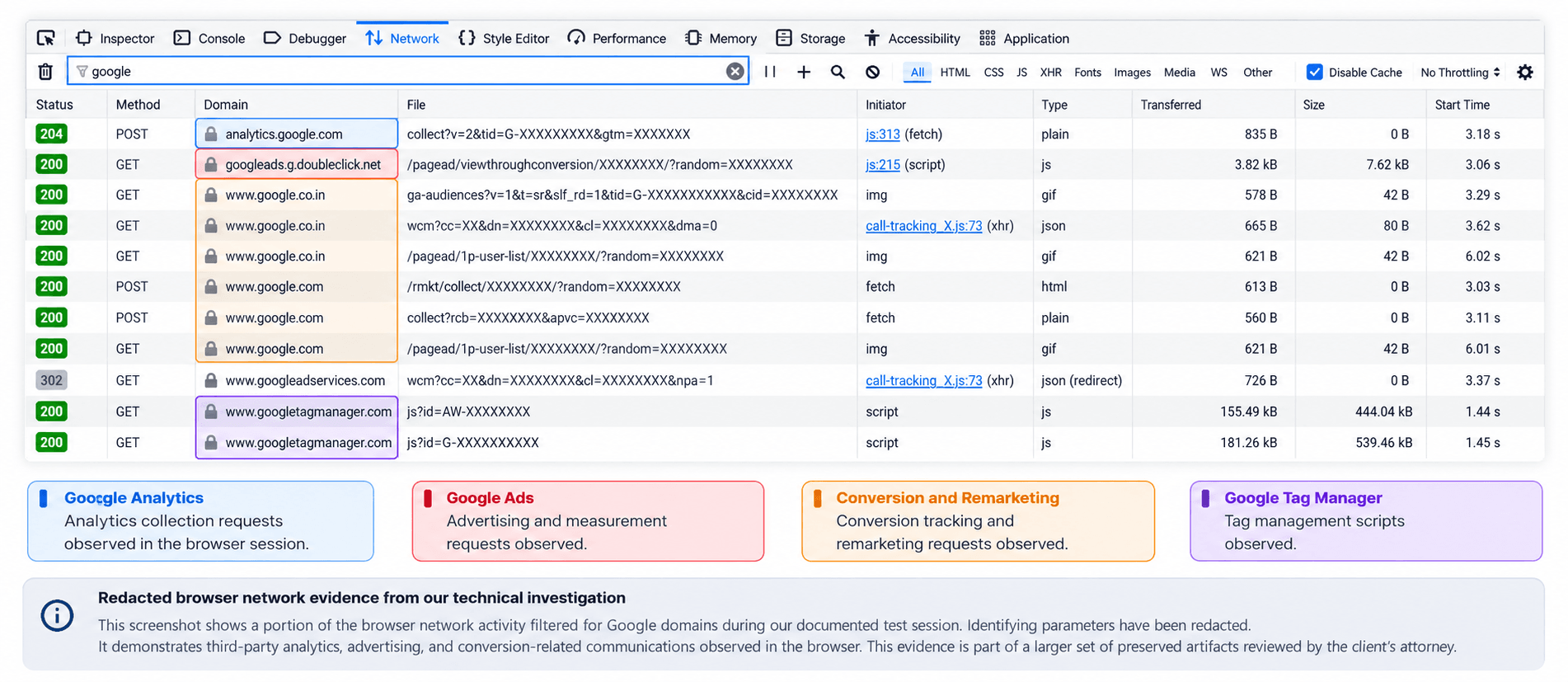
- HAR files and network captures: Request destinations, initiation times, request parameters, and observable initiators. See Google's Chrome DevTools Network reference for background on browser network inspection.
- Screenshots and browser-state checkpoints: The fresh homepage condition, visible consent interface state, cookies, and relevant local storage.
- Authorized portal workflow records: Login, session-cookie behavior, authenticated navigation, logout, and post-logout access checks.
- Evidence manifests and SHA-256 hashes: Traceability between original captures, reviewed derived files, and report findings.
- Allegation mapping and verified findings: A way to distinguish reproduced observations from partially reproduced, indeterminate, and historical questions.
The finalized CIPA evidence set consisted of 57 raw or restricted-raw artifacts and 24 human-verified derived artifacts, totaling 81 hashed technical evidence artifacts. Credential-bearing authentication evidence was kept restricted rather than embedded in the ordinary report.
Example: How an Allegation Was Mapped to Evidence
The following client-neutral summary is adapted from verified findings in the technical report. It illustrates the assessment format; it is not a screenshot of the original report, a copy of a raw HAR file, or a representation of legal findings.
| Question in the demand materials | Observed technical evidence | Assessment and limitation |
|---|---|---|
| Did named third-party request families occur before intentional visitor interaction? | Five complaint-referenced analytics/advertising request families appeared 6.189 to 10.622 seconds after the initial document request, before an intentional click, scroll, or form action. No visible consent-management interface appeared first. Supported by the fresh-baseline HAR, screenshots, and human-verified timing analysis. | Reproduced for the tested current session. The result does not reconstruct the claimant's earlier session or determine consent sufficiency or CIPA liability. |
| Could the browser capture establish the exact source IP address received or logged by third-party vendors? | The HAR showed browser requests to external destinations but did not expose the exact source IP as received or logged by remote servers. | Unable to determine. Vendor-side receipt, logging, retention, and historical behavior were outside the available browser evidence. |
That mix of affirmative findings and explicit unknowns is important. Auditzo did not try to disprove every allegation or assume that every tracking request established a legal violation. The role was to provide facts the attorney could evaluate.
How Can Technical Evidence Help Your Attorney Evaluate CIPA Allegations?
When a business receives a CIPA website tracking demand letter, its attorney needs reliable technical facts, not just automated compliance scores.
Download our 4-page Technical Evidence Brief to see how Auditzo uses HAR files, browser network captures, screenshots, and allegation-to-evidence mapping to help attorneys evaluate technical claims, identify evidentiary gaps, and make informed decisions.
Download the Technical Evidence Brief (PDF)
Based on documented technical investigation methods. Technical evidence support only; not legal advice.
Five Technical Questions Answered for Counsel
Beyond the demand-letter assertions, Auditzo addressed questions about portal authentication, browser-visible session maintenance, categories of information observable during testing, possible third-party sign-in or sign-out flows, and observable AI functionality. The investigation described what one authorized browser journey showed without inferring unseen server-side systems or claiming the person making the allegations had accessed the portal.
What the CIPA Investigation Found
1. Analytics and Advertising Requests Appeared Before Interaction
During the fresh homepage baseline, all five request families named in the draft complaint were observed before any intentional visitor action. First occurrences were approximately 6.2 to 10.6 seconds after the initial document request, and no visible cookie/consent interface appeared before them. This established the tested sequence, not what a claimant saw on an earlier visit or whether the sequence violated a statute.
2. Browser-Level Identifiers Persisted Across Pages
Selected analytics and advertising identifiers and call/conversion values remained stable as page URLs changed across the tested public-site journey. The evidence supported cross-page browser correlation in that session. It did not establish that an identifier named a person or prove vendor-side profiling, retention, enrichment, or downstream use.
3. Authenticated Page Context Appeared in Third-Party Requests
During limited authorized portal navigation, third-party analytics and advertising requests continued, and some included authenticated route or page URL context. The evidence did not show that individual training records, certificates, or test-result contents were transmitted. The tested first-party login and session-cookie lifecycle was also documented.
4. The Allegations Were Classified, Not Simply Accepted or Rejected
| Assessment | Count |
|---|---|
| Reproduced in current testing | 3 |
| Partially reproduced | 2 |
| Unable to determine | 3 |
| Historical evidence required | 2 |
| Not reproduced | 0 |
These classifications describe technical propositions only. They are not scores of legal merit. In particular, the available material could not authenticate the complainant's original browser session, and a browser HAR alone cannot establish how a remote vendor stored or later used information.
For a similar allegation-specific review, see Auditzo's manual website tracking evidence audit approach.
The Second Workstream: WCAG 2.2 Accessibility Assessment
After the tracking investigation, the engagement also included a representative WCAG 2.2 Level A/AA accessibility audit. This combined automated discovery with manual keyboard testing, NVDA screen-reader review, semantic inspection, visual contrast measurement, and narrow-viewport testing against the W3C WCAG 2.2 standard.
The accessibility workstream documented 19 consolidated verified findings. Representative examples included:
- Keyboard navigation: Focus-triggered submenus lacked a verified in-place dismissal method, and expanded/collapsed status was not consistently exposed to assistive technology.
- Informative images: Fourteen visible product photographs had empty alternative text, hiding useful visual information from screen-reader users.
- Required-field indicators: Important asterisks on inquiry forms had approximately 1.14:1 to 1.15:1 contrast against their backgrounds.
- Reflow: Some pagination controls were clipped at a 320 CSS-pixel viewport.
These were actionable findings tied to user impact and recommendations, rather than a generic automated accessibility score. The W3C WCAG Evaluation Methodology explains why defined scope, representative sampling, and clear reporting matter in accessibility assessments.
From Findings to Production Changes
The client did not have to take the reports to an unrelated developer to begin the next phase. Auditzo's engineering team implemented the agreed production changes on the live website after the technical assessments.
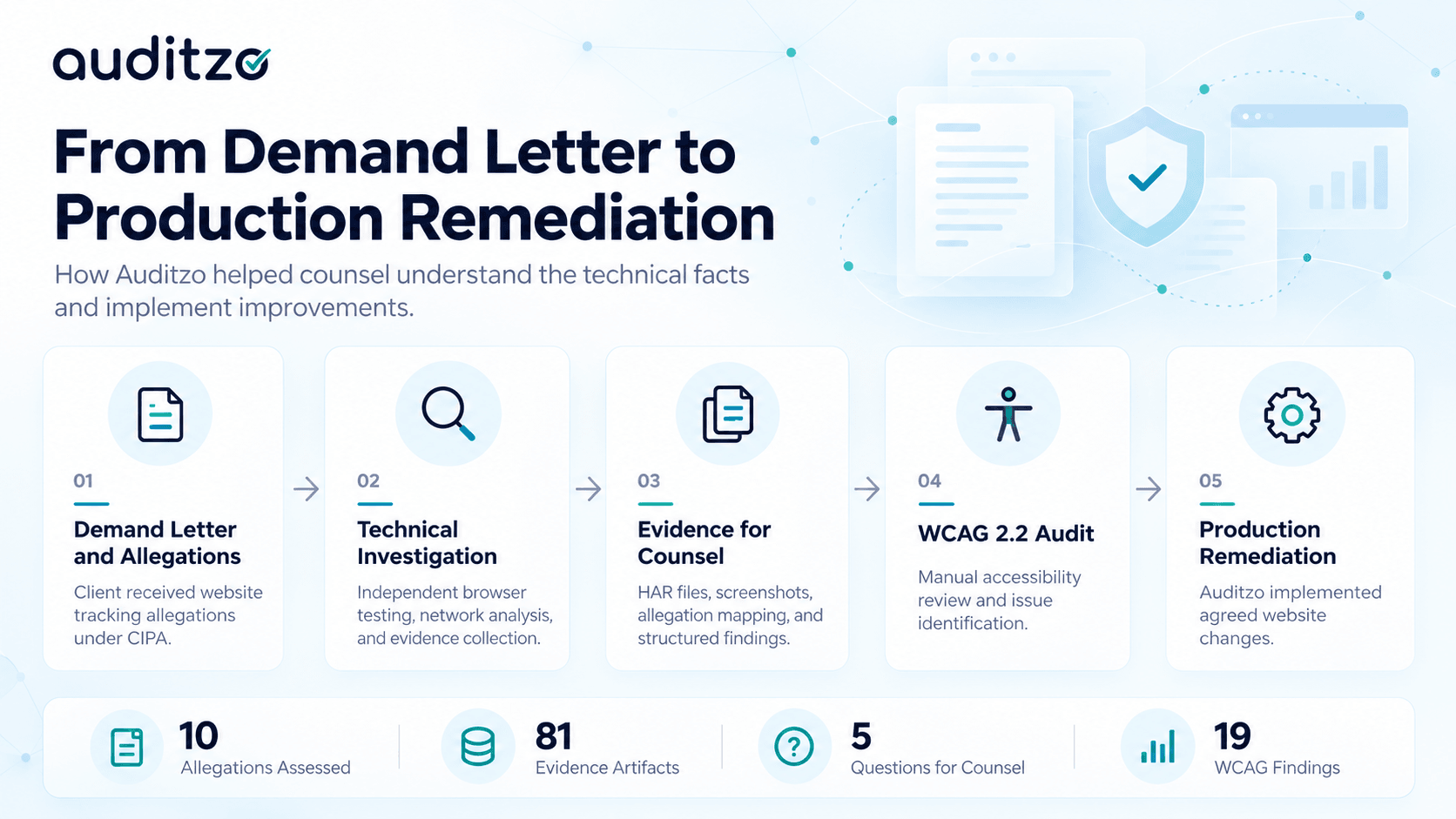
That continuity mattered commercially: the same provider could explain the observed tracking behavior, document accessibility barriers, communicate actionable recommendations, and execute the agreed implementation work. The original CIPA evidence review and subsequent remediation were separate phases of the engagement.
For comparable needs, Auditzo offers website tracking remediation and accessibility remediation support. This case study does not claim a particular code change or post-remediation network result that is not documented in the materials available for publication.
Results and Business Value
- For the attorney: A structured, allegation-specific technical record with reproducible observations, cited evidence, and clear limits, plus answers to five additional questions.
- For technical stakeholders: An organized CIPA evidence set containing 81 hashed artifacts across documented sessions, with sensitive raw captures controlled.
- For accessibility stakeholders: Nineteen verified WCAG 2.2 findings explaining affected interactions, user impact, and remediation direction.
- For the business: Agreed production changes implemented by the Auditzo team, taking the engagement beyond report delivery.
The engagement was completed. Its documented result was stronger technical clarity for the client and counsel, a detailed accessibility assessment, and implemented website improvements. This is not a claim that the demand-letter matter was legally resolved, that the website was certified WCAG conformant, or that every change received independent post-remediation testing.
Received a Website Tracking Demand Letter? Get Technical Evidence Your Attorney Can Review.
If your business has received CIPA-related website tracking allegations, your attorney may need more than a list of cookies or an automated scan. Auditzo can scope browser/network testing around the specific assertions, document observable request behavior, produce traceable technical findings, and discuss remediation where appropriate.
Contact Auditzo to discuss your website tracking allegations and technical evidence needs.
Law firms can also review our technical evidence services for counsel and a related CIPA evidence case study.
Client confidentiality and scope: The client's identity and identifying project details have been withheld. This case study is based on a completed technical engagement. Auditzo provided technical evidence to inform counsel's assessment and subsequently implemented agreed website improvements. Legal advice, litigation strategy, liability determinations, legal dispute outcomes, complete WCAG conformance, and comprehensive independent post-remediation verification are not claimed.