Digital Evidence in Privacy Cases: Authentication Standards and 10 Case Examples
Digital evidence appears in privacy disputes in many forms: text messages, social-media records, cloud exports, browser-network requests, cookies, screenshots, server logs, location records, biometric databases, access logs, and security records.
But a technical artifact does not become reliable or legally usable merely because it is digital, timestamped, exported, or hashed. Reviewers still need to understand where it came from, how it was collected, what it contains, what may be missing, how it connects to the disputed event, and what legal question it is being used to address.
This guide explains the difference between digital-evidence authentication, admissibility, relevance, evidentiary weight, and technical reliability. It also reviews ten court, regulatory, and enforcement examples from 2020 through 2025 that involved electronic communications, website interactions, international data transfers, transparency, health information, biometric data, or cybersecurity records.
The examples do not establish one universal digital privacy evidence standard. They arise from different laws, jurisdictions, procedural stages, and factual records. Their practical value lies in showing why privacy teams and counsel need evidence that is scoped, traceable, accurately described, and supported by the relevant source record.
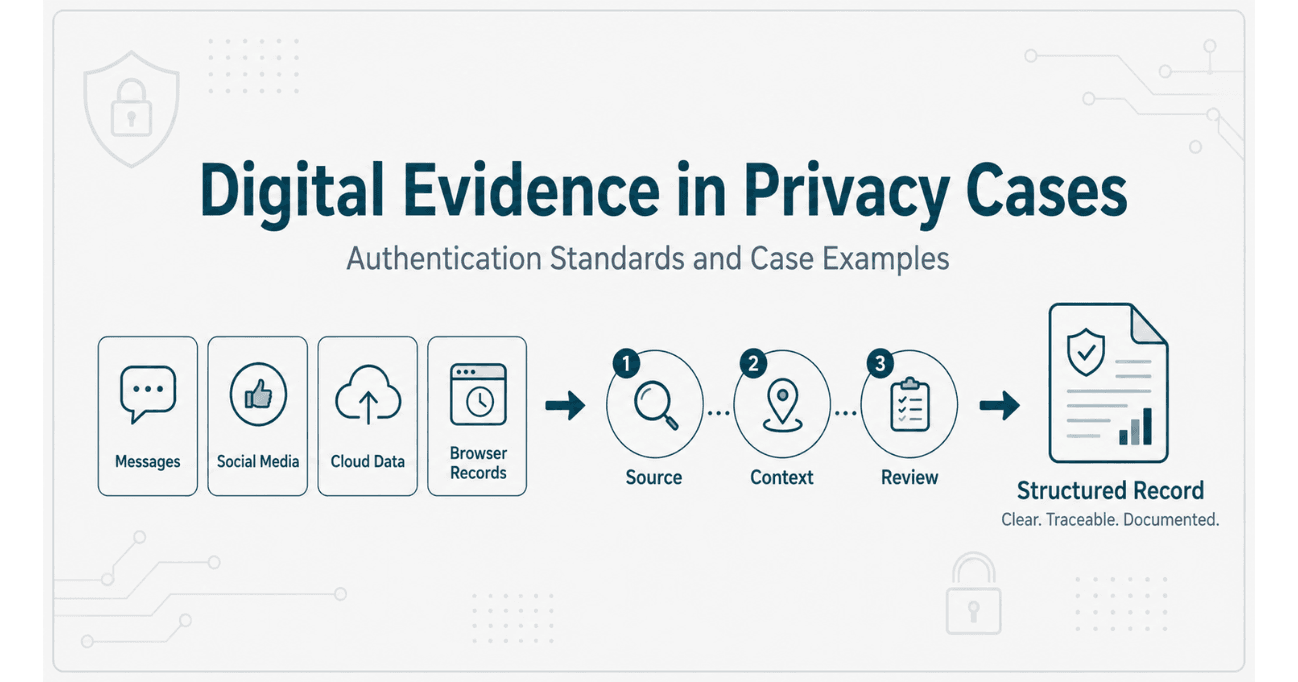
Key point: Authentication asks whether an item is what its proponent claims. It does not automatically resolve admissibility, hearsay, relevance, completeness, legal liability, statutory coverage, consent, or the weight a court or regulator should give the evidence.
What Is Digital-Evidence Authentication?
Authentication is the process of providing a sufficient foundation to support the claim that an item is what the person offering it says it is.
For example, a party may claim that an exhibit is:
- A screenshot taken from a particular website on a stated date
- A message sent by a particular account
- An export obtained from a cloud platform
- A browser-network record captured during a defined session
- A copy of data extracted from a device
- A system-generated access log
- A record maintained in the ordinary course of business
The required foundation depends on the item, jurisdiction, proceeding, purpose, and applicable evidence rules.
In United States federal proceedings, Federal Rule of Evidence 901 provides a general authentication standard. Its examples include testimony from a witness with knowledge, distinctive characteristics, and evidence describing a process or system and showing that it produces an accurate result.
Federal Rule of Evidence 902 also identifies categories of self-authenticating evidence. Rules 902(13) and 902(14) address certain certified records generated by electronic processes or systems and certain data copied from electronic devices, storage media, or files.
These rules do not mean that every digital file is automatically admissible. Other objections or requirements may still involve:
- Relevance
- Hearsay
- Privilege
- Best-evidence rules
- Completeness
- Unfair prejudice
- Expert testimony
- Discovery compliance
- Privacy or confidentiality restrictions
Official reference: Federal Rules of Evidence.
Authentication, Admissibility, Relevance, and Weight Are Different
These concepts are related, but they should not be treated as interchangeable.
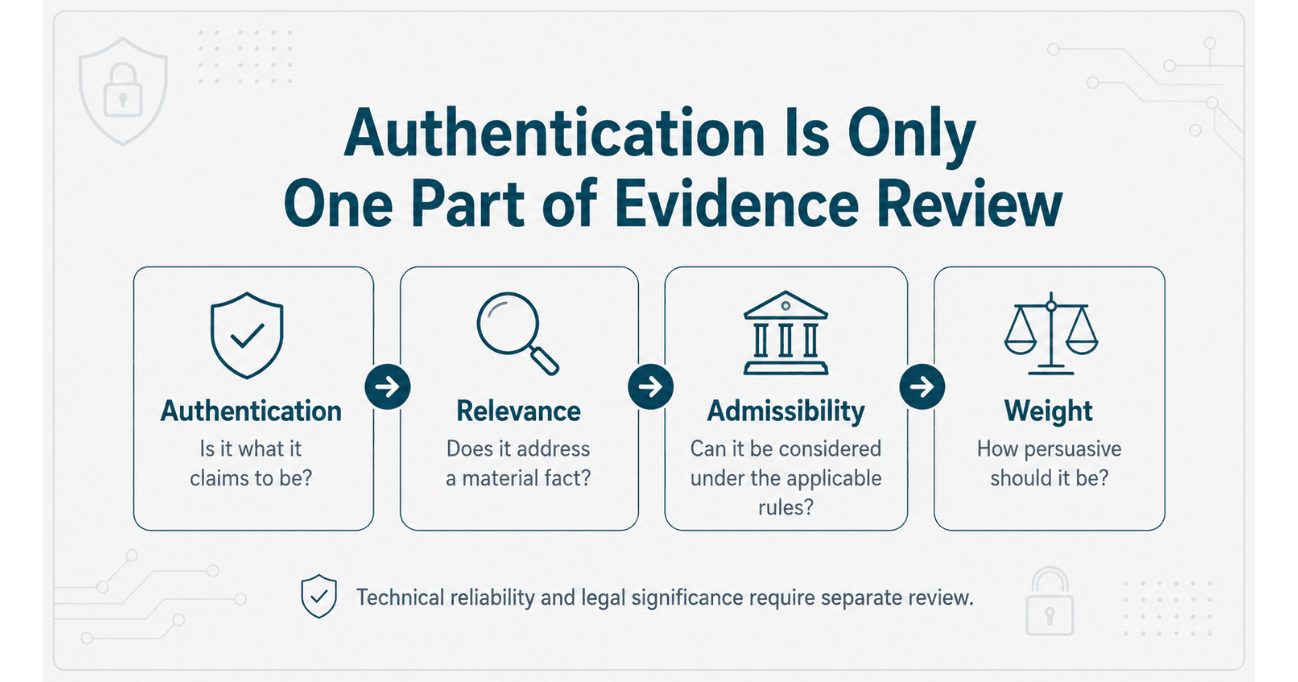
| Question | What It Generally Concerns |
|---|---|
| Authentication | Is the item what its proponent claims it is? |
| Relevance | Does the item tend to make a material fact more or less probable? |
| Admissibility | May the item be considered under the applicable procedural and evidence rules? |
| Weight | How persuasive or reliable should the fact finder consider it? |
| Completeness | Does the item provide the necessary surrounding context? |
| Technical reliability | Was the information collected, preserved, processed, and described using supportable methods? |
| Legal significance | Does the evidence satisfy or help prove the elements of a particular legal claim or defense? |
A technically accurate file can still face legal objections
A browser export may accurately represent the requests recorded by a browser during a session, but the offering party may still need to establish:
- Who performed the capture
- Which website and page were reviewed
- How the session was prepared
- Whether prior cookies or preferences existed
- Which browser and settings were used
- Whether the file is complete for the purpose claimed
- Whether sensitive information was altered or redacted
- Whether the record is relevant to the disputed legal issue
A legal ruling does not validate every technical inference
A court may allow a claim to proceed at the pleading stage without deciding whether the plaintiff’s factual allegations are true. A regulator may announce allegations before a court determines liability. A settlement may impose restrictions without containing an adjudicated admission of every allegation.
The procedural posture must therefore be stated accurately.
Common Types of Digital Evidence
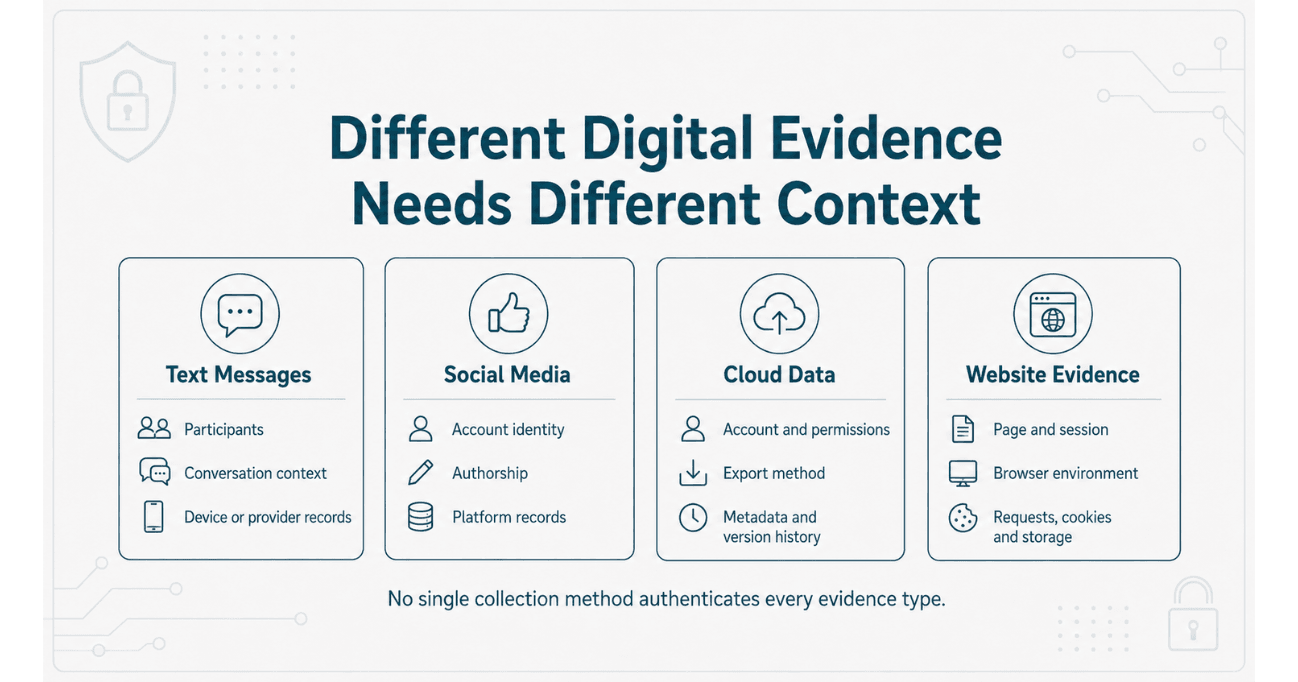
Text messages and messaging-app records
These may include screenshots, native exports, device extractions, account records, message databases, attachments, timestamps, participant information, and service-provider records.
Social-media records
These may include account pages, posts, direct messages, photographs, videos, comments, account identifiers, platform exports, and records supplied by the platform.
Cloud data
Cloud evidence may include files, document histories, audit logs, authentication logs, account activity, access records, object metadata, version histories, backups, and provider-generated exports.
Website screenshots
A screenshot may document visible content, a consent banner, an interface choice, an error, a page state, or a developer-tools view at a particular moment.
Browser-network records and HAR files
These may document requests recorded by the browser, including URLs, hostnames, methods, status codes, timing, resource types, selected headers, redirects, and other exported fields.
Cookies and browser storage
These may document cookie names, associated domains, paths, attributes, expiration values, local-storage keys, session-storage keys, and differences between separately prepared sessions.
Server and application logs
These may document account activity, requests, errors, access, authentication, configuration changes, administrative actions, and other system events.
Security and incident-response evidence
This may include access logs, identity and access-management records, security alerts, endpoint records, network telemetry, vulnerability information, incident timelines, and remediation records.
Biometric and model-related records
These may include source images, biometric templates, feature vectors, model inputs, search queries, match results, training-data provenance, API records, and rights-request logs.
Important: The presence of a file or field does not establish its purpose, accuracy, completeness, ownership, authorship, or legal significance. Those questions require additional context.
For a focused comparison, review Screenshots, Logs, and HAR Files: What Each Website Tracking Evidence Format Can Document.
How Text Messages May Be Authenticated
A screenshot of a text conversation may be useful, but it does not automatically establish who sent the messages or whether the displayed conversation is complete.
Depending on the matter, authentication support may include:
- Testimony from a sender, recipient, or witness with knowledge
- Telephone numbers associated with the participants
- Distinctive content known to the alleged sender
- Consistent writing patterns, nicknames, photographs, or account details
- Replies showing an ongoing conversation
- Device records
- Native message exports
- Service-provider records
- Backup or cloud records
- Forensic extraction reports
- Metadata and timestamps
Questions to document
- Was the evidence captured as screenshots, an export, or a device extraction?
- Are the sender, recipient, date, and time visible?
- Are earlier and later messages available for context?
- Were attachments included?
- Was the conversation edited, filtered, cropped, or redacted?
- Does another device, account, backup, or provider record corroborate it?
- Can a witness explain how the messages were received or preserved?
A missing native export does not necessarily make a screenshot unusable. At the same time, a screenshot may provide less context than the original message database or platform export.
How Social-Media Evidence May Be Authenticated
A social-media username alone may not establish authorship. Accounts can be shared, impersonated, compromised, or accessed by another person.
Possible authentication evidence includes:
- Platform records connecting an account identifier to account information
- Testimony from a person who communicated with the account
- Account photographs or profile details
- Distinctive facts contained in messages
- Associated email addresses or telephone numbers
- Login or device records
- Consistent account history
- Native platform exports
- Witness testimony about how the exhibit was collected
The evidence supporting account ownership may be different from the evidence supporting authorship of a particular post or message.
A reviewer should therefore separate:
Account identification
Specific-message authorship
Accuracy of the displayed content
Completeness of the conversation
Time and date information
Method of collection
Later edits or deletions
Legal relevance
How Cloud Data and Platform Exports May Be Authenticated
Cloud evidence may come from a user-controlled account, an administrator export, an application programming interface, an e-discovery collection, a provider response, or a forensic acquisition.
A useful foundation may document:
- The platform and account involved
- The person or process that performed the export
- The permissions used
- The export date and time
- The selected date range
- The export format
- Provider-generated manifests or certificates
- Object identifiers and version numbers
- File paths and folder context
- Metadata retained or omitted
- Hash values associated with particular file versions
- Processing performed after collection
Cloud export limitations
An export may not contain every item that once existed in the account. Limitations may arise from:
- Retention settings
- Deleted or overwritten records
- Insufficient account permissions
- Export-date restrictions
- Application-specific omissions
- Unavailable audit-log tiers
- Synchronization delays
- Redaction
- Changes in provider functionality
A provider-generated export can be highly useful, but the report should not call it complete unless the basis for completeness is defined and supportable.
Website Tracking and Browser Evidence
Website privacy reviews often involve a narrower category of digital evidence than full device or cloud forensics.
A browser-based review may document:
- The visible website and consent interface
- Reviewer interactions
- Requests recorded during the session
- Cookies and browser-storage items
- Scripts and third-party hostnames
- Differences between Initial, Reject, Accept, or other scoped states
- Page-specific activity
- Selected screenshots and report extracts
What browser evidence does not automatically establish
- All server-side processing
- All downstream vendor activity
- Who legally controlled the processing
- Whether a value was personal data
- Whether consent was legally required
- Whether consent was valid
- Whether an exception or other lawful basis applied
- Whether a legal violation occurred
- Whether an artifact is admissible in a particular proceeding
A report should connect each observation to its specific page, environment, session, reviewer action, and supporting artifact.
For a reporting structure, see the GDPR Cookie Tracking Evidence Report Template.
Ten Digital Evidence and Privacy Case Examples
The following examples are not all final court judgments.
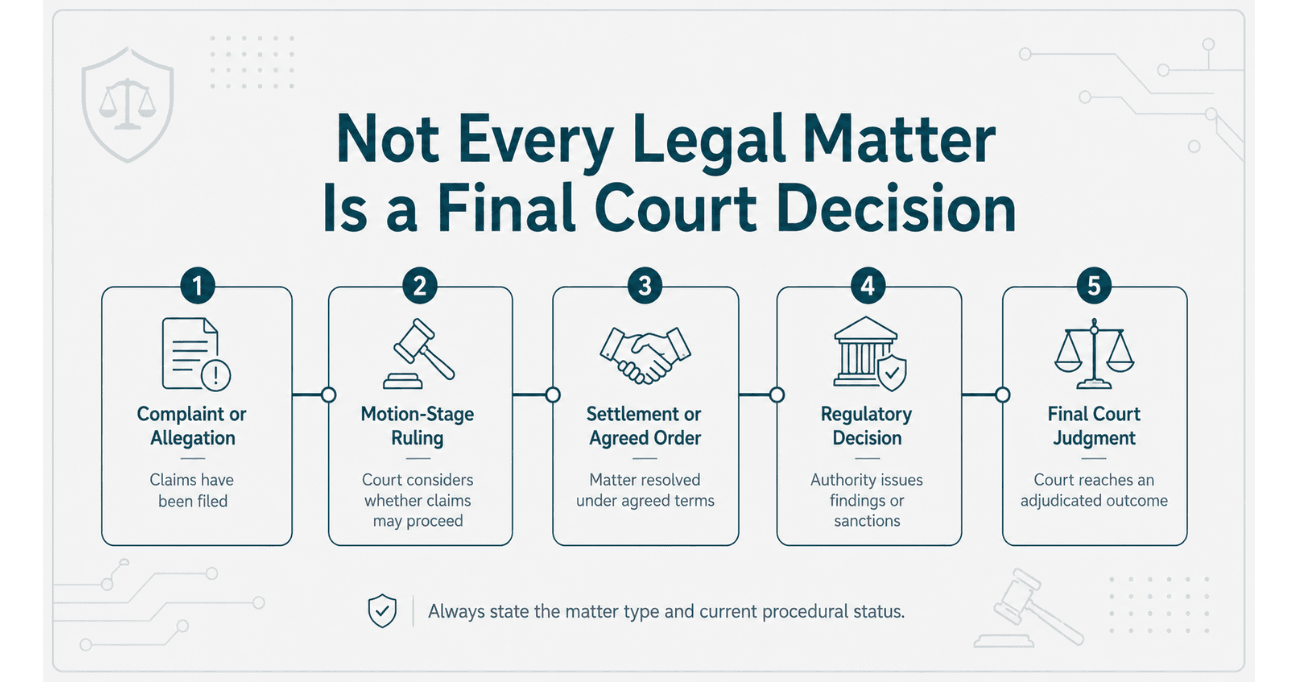
They include:
- Court decisions
- An unpublished appellate disposition
- Regulatory decisions
- A formal enforcement action resolved by stipulated order
- An administrative settlement
- Pending civil-penalty proceedings
Each example is classified so readers can distinguish allegations, procedural rulings, regulatory findings, settlements, and final court outcomes.
| Example | Jurisdiction | Matter Type | Primary Evidence Theme |
|---|---|---|---|
| People v. Kingsberry | New York, United States | Appellate court decision | Authentication of Facebook account content |
| Javier v. Assurance IQ | Ninth Circuit, United States | Unpublished appellate disposition | Website interaction recording and prior consent allegations |
| Schrems II | European Union | CJEU judgment | International transfers and protection assessment |
| WhatsApp Ireland | European Union and Ireland | Regulatory decision | Transparency and description of processing |
| Clearview AI | France | Regulatory sanction | Image collection, biometric processing, and rights handling |
| GoodRx | United States | FTC and DOJ enforcement resolved by stipulated order | Health information and advertising disclosures |
| BetterHelp | United States | FTC administrative order | Health information and advertising disclosures |
| Meta Pixel Healthcare Litigation | Federal court, United States | Civil litigation and motion-stage rulings | Tracking pixels and patient-related website activity |
| Australian Clinical Labs | Australia | Federal Court civil-penalty decision | Security controls, breach response, and privacy obligations |
| Medibank | Australia | Pending civil-penalty proceedings | Cybersecurity controls and protection of personal information |
1. People v. Kingsberry: Authenticating Facebook Records
Jurisdiction: New York, United States
Matter type: Appellate criminal decision
Decision date: May 12, 2021
What the court addressed
The defendant challenged the authentication of Facebook photographs and messages. The New York Appellate Division concluded that the account had been properly authenticated.
Authentication evidence described by the court
The court referred to:
- Testimony from a Facebook representative linking a unique identifier to the username and vanity name used when the account was created
- Testimony from a witness who had known the defendant for many years
- The witness’s testimony that they communicated with the defendant almost daily through the identified account
What the decision illustrates
Digital evidence can be authenticated through a combination of platform records and witness testimony. No universal rule requires the same foundation in every case.
What the decision does not establish
The decision does not mean that every Facebook screenshot or account export is automatically authentic. It also does not establish a privacy-law violation.
Technical-review takeaway: Preserve account identifiers, collection context, platform records where available, and testimony from people with knowledge of the account or communication.
Official source: People v. Kingsberry, 2021 NY Slip Op 03054.
2. Javier v. Assurance IQ: Website Recording and Prior Consent Allegations
Jurisdiction: United States Court of Appeals for the Ninth Circuit
Matter type: Unpublished, nonprecedential appellate disposition
Decision date: May 31, 2022
What the plaintiff alleged
The plaintiff alleged that a third-party product recorded his interactions with an insurance-quote website while he entered information. He claimed he had not provided valid prior consent before the alleged recording occurred.
What the Ninth Circuit decided
The Ninth Circuit reversed the dismissal and concluded that the plaintiff had plausibly alleged a lack of express prior consent under the provision considered by the court.
The court remanded the matter and expressly did not decide several other arguments that the district court had not reached.
What this procedural posture means
A reversal of dismissal is not a final finding that the alleged recording occurred exactly as claimed or that the defendants were ultimately liable.
Technical-review takeaway
Where consent timing is disputed, useful documentation may include:
- The page and visitor journey
- The moment the recording technology loaded
- The visible notice or consent interface
- The reviewer’s actions
- Related scripts and network requests
- The timing of any agreement or consent action
- The technical limitations of the capture
Official source: Javier v. Assurance IQ, No. 21-16351.
For CIPA terminology and scope boundaries, review What Is Trap and Trace Under CIPA? A Website Technical Review Guide.
3. Schrems II: International Transfers Require More Than Contract Language
Jurisdiction: Court of Justice of the European Union
Matter type: Grand Chamber judgment
Decision date: July 16, 2020
What the judgment decided
In Case C-311/18, the Court invalidated the EU-US Privacy Shield adequacy decision. It did not invalidate the European Commission’s standard contractual clauses decision considered in the case, but the judgment emphasized the need to assess whether transferred data receives the protection required by EU law in the circumstances of the transfer.
Evidence and documentation implications
A transfer review may require more than identifying a contract.
Depending on the processing, relevant documentation may include:
- Data-flow maps
- Destination countries
- Recipient and subprocessor information
- Categories of transferred data
- Purposes of processing
- Access controls
- Encryption and key-control arrangements
- Onward-transfer arrangements
- Applicable transfer mechanisms
- Assessment of third-country law and practice
What browser evidence can contribute
Browser records may identify observed requests to external hostnames. They do not independently determine:
- The recipient’s legal role
- The complete transfer chain
- Where all processing occurred
- Which transfer mechanism applied
- Whether supplementary measures were sufficient
Technical-review takeaway: Network evidence can help identify questions for a transfer assessment, but it is not a substitute for legal, contractual, infrastructure, and vendor documentation.
Official source: Case C-311/18, Data Protection Commissioner v. Facebook Ireland and Maximillian Schrems.
4. WhatsApp Ireland: Transparency Must Reflect the Processing Being Described
Jurisdiction: Ireland and the European Union cooperation procedure
Matter type: Regulatory decision following an EDPB dispute-resolution process
Final decision announced: September 2, 2021
What the inquiry concerned
The Irish Data Protection Commission examined whether WhatsApp Ireland complied with GDPR transparency obligations concerning information provided to users and non-users.
Following the European Data Protection Board’s binding decision, the Irish authority adopted its final decision and imposed a fine.
Why this matters for digital evidence
A transparency review may require teams to connect:
- The wording presented to users
- The categories of information processed
- The purposes described
- The recipients or recipient categories
- Controller and processor roles
- Retention information
- Actual system behavior
What screenshots and logs can show
Screenshots may document the information visible to a user. Technical records may help identify observable processing behavior. Neither source alone necessarily provides a complete transparency assessment.
What this example does not establish
It does not mean that every unclear privacy notice produces the same outcome or fine. The decision concerned a particular organization, processing system, factual record, and cooperation procedure.
Technical-review takeaway: A credible transparency review compares the visible explanation against a documented and verified processing inventory rather than relying on either source in isolation.
Official sources:
5. CNIL Enforcement Against Clearview AI: Collection Provenance and Biometric Processing
Jurisdiction: France
Matter type: Regulatory sanction
Decision date: October 17, 2022
What the matter involved
Clearview AI developed a facial-recognition service using a large database of images collected from publicly accessible internet sources.
The French supervisory authority’s restricted committee imposed a €20 million administrative fine and issued compliance orders concerning the processing addressed in its decision.
Evidence categories relevant to this type of review
- Sources of collected images
- Collection methods
- Dates and scale of collection
- Biometric-template generation
- Search and matching activity
- Customer or user queries
- Retention and deletion controls
- Data-subject access and erasure requests
- Responses to regulator requests
Why public availability is not the end of the analysis
The fact that an image was publicly viewable does not by itself resolve the lawfulness of collecting it at scale, creating a biometric template, adding it to a searchable database, or offering facial-recognition services.
What a technical reviewer should avoid
A reviewer should not infer that a particular person’s image appears in a database merely from general descriptions of the technology. That conclusion requires matter-specific evidence.
Technical-review takeaway: AI and biometric reviews need traceable data provenance, processing records, model or system documentation, and rights-handling evidence—not only a public-facing description of the product.
Official source: CNIL Restricted Committee Deliberation No. SAN-2022-019.
6. FTC and DOJ Action Against GoodRx: Health Information and Advertising Disclosures
Jurisdiction: United States
Matter type: Federal enforcement action resolved through a stipulated order
Action announced: February 1, 2023
What the government alleged
The Federal Trade Commission alleged that GoodRx shared health-related and personal information with advertising platforms and failed to provide required breach notifications under the Health Breach Notification Rule.
The proposed stipulated order was filed by the Department of Justice on behalf of the FTC. It included a civil penalty and restrictions on disclosures for advertising.
Evidence categories relevant to this matter type
- Software development kits and tracking technologies
- Data-sharing configurations
- Events sent to advertising platforms
- Account identifiers
- Health-related searches and activity
- Internal privacy representations
- Vendor relationships
- Advertising audiences and campaigns
- Consent and authorization records
Procedural boundary
A stipulated order resolves an enforcement matter under agreed terms. It should not be described as though a trial court independently found every allegation true after a contested trial.
Technical-review takeaway
A website or application review should connect each integrated advertising or analytics technology to:
- The data fields configured for transmission
- The pages or actions that trigger transmission
- The recipient
- The stated purpose
- The organization’s disclosure and authorization framework
Official sources:
7. FTC Action Against BetterHelp: Promises, Data Flows, and Advertising Use
Jurisdiction: United States
Matter type: FTC administrative order
Final approval: July 14, 2023
What the FTC alleged
The FTC alleged that BetterHelp shared sensitive health-related information with advertising platforms after making privacy representations to consumers.
The finalized order included restrictions on sharing health data for advertising and required a payment associated with consumer refunds.
Why evidence needs multiple layers
A review may need to compare:
- Statements made to consumers
- Questionnaire or intake fields
- Advertising-platform integrations
- Identifiers and event parameters
- Audience-building activity
- Data-use purposes
- Vendor instructions
- Internal access and retention
What a network request alone may not show
A browser request may identify the recipient and visible fields within the capture. It may not reveal every later use, matching operation, audience process, retention period, or internal instruction.
Technical-review takeaway
Browser evidence should be combined with configuration records, vendor dashboards, contracts, product documentation, and internal processing records where the scope requires a broader data-use assessment.
Official sources:
8. In re Meta Pixel Healthcare Litigation: Tracking Technology on Health-Related Websites
Jurisdiction: United States District Court for the Northern District of California
Matter type: Consolidated civil litigation
Example reviewed: Motion-stage rulings beginning in 2022
What the litigation alleged
The plaintiffs alleged that healthcare providers’ websites or patient portals used the Meta Pixel in ways that transmitted information associated with users’ health-related website activity.
Why this example requires procedural care
Motion-to-dismiss rulings assess whether pleaded allegations are sufficient under the applicable standard. They do not necessarily represent final findings about every alleged transmission, every defendant, or ultimate liability.
Potentially relevant evidence categories
- Page URLs and path information
- Pixel event names
- Request parameters
- Cookies and browser identifiers
- Login or portal context
- Form and appointment activity
- Website source code and tag configuration
- Advertising-platform settings
- Provider and vendor documentation
Do not assume all health-page tracking is identical
The technical and legal assessment may differ depending on:
- Whether the page was public or authenticated
- The information transmitted
- The user’s relationship with the provider
- The technology’s configuration
- The recipient and purpose
- The applicable healthcare and privacy framework
Technical-review takeaway: Evidence should connect the specific page, session, request, identifiers, and visible user context. General statements that a pixel existed are not a substitute for page-level analysis.
Official case record: In re Meta Pixel Healthcare Litigation, No. 3:22-cv-03580.
9. Australian Clinical Labs: Final Civil Penalties After a Data Breach
Jurisdiction: Federal Court of Australia
Matter type: Civil-penalty decision
Decision announced: October 9, 2025
What the outcome involved
The Federal Court ordered Australian Clinical Labs to pay civil penalties concerning the Medlab Pathology data breach. The Australian Information Commissioner described the decision as the first civil penalties ordered under Australia’s Privacy Act.
Evidence and documentation themes
A security-related privacy matter may involve:
- Information-security governance
- Risk assessments
- Vulnerability management
- Monitoring and detection
- Incident-response actions
- Access and authentication controls
- Data-retention practices
- Board and management oversight
- Regulator notifications
- Records showing when corrective actions occurred
Why this differs from a website cookie review
A browser-based website audit cannot assess an organization’s complete cybersecurity program, internal systems, incident response, or protection of databases.
Technical-review takeaway
Privacy evidence can extend far beyond browser requests. The evidence type must match the allegation and system under review.
Official source: OAIC announcement concerning Australian Clinical Labs.
10. OAIC Proceedings Against Medibank: Alleged Failures to Protect Personal Information
Jurisdiction: Federal Court of Australia
Matter type: Pending civil-penalty proceedings
Proceedings announced: June 5, 2024
What the Commissioner alleges
The Australian Information Commissioner alleges that Medibank failed to take reasonable steps to protect the personal information it held from misuse, unauthorized access, or disclosure during the period identified in the proceeding.
Current procedural boundary
These are allegations before the court. The filing of civil-penalty proceedings is not itself a final liability judgment.
As of Auditzo’s August 2026 update to this article, the OAIC has publicly stated that the Medibank civil-penalty proceeding continues.
Evidence likely relevant to the pleaded issues
The Commissioner’s concise statement describes alleged deficiencies involving cybersecurity and the protection of personal information. A matter of this kind may require evidence concerning:
- Authentication controls
- Privileged access
- Security monitoring
- Alert handling
- Threat detection
- Risk management
- Data holdings
- Incident chronology
- Remediation decisions
Technical-review takeaway
Always distinguish allegations in a filed case from findings in a final judgment. Reports should state the procedural status as of the date of publication or update.
Official sources:
What These Examples Actually Show
There is no single global digital evidence standard
The examples involve different:
- Jurisdictions
- Statutes
- Evidence rules
- Regulators
- Procedural stages
- Technical systems
- Legal questions
A method suitable for authenticating a social-media account is not automatically sufficient for proving a cross-border transfer, a security failure, a biometric-processing operation, or a website-recording claim.
The evidence must match the proposition
| Proposition | Potential Supporting Material | Remaining Questions |
|---|---|---|
| A message came from a particular account | Platform record, witness testimony, account identifiers, distinctive content | Who authored the specific message and whether the exhibit is complete |
| A request occurred during a website session | Browser-network record, HAR entry, screenshot, session notes | Purpose, downstream use, legal significance, and completeness |
| A cookie existed | Cookie record, browser storage, response header | Purpose, necessity, transmission, consent requirement, and legal classification |
| Data moved to a third country | Network records, architecture, vendor and hosting documentation | Recipient role, transfer mechanism, onward transfers, and protections |
| An organization lacked reasonable security | Risk records, access logs, controls, alerts, incident and remediation evidence | Applicable duty, reasonableness, causation, and liability |
| A privacy notice was incomplete | Notice version, screenshots, processing inventory, configuration and data flows | Applicable transparency requirements and materiality |
Corroboration is often more useful than artifact ranking
It is misleading to assign universal labels such as:
Screenshot = weak evidence
HAR = strong evidence
Packet capture = strongest evidence
The correct question is whether the artifact is appropriate and sufficiently supported for the proposition being advanced.
A screenshot may be central to an interface dispute. A HAR file may be useful for browser-network timing. A server log may be necessary for account activity. A witness may be essential for authorship. A contract may be central to controller-processor roles.
Digital Evidence Documentation Framework
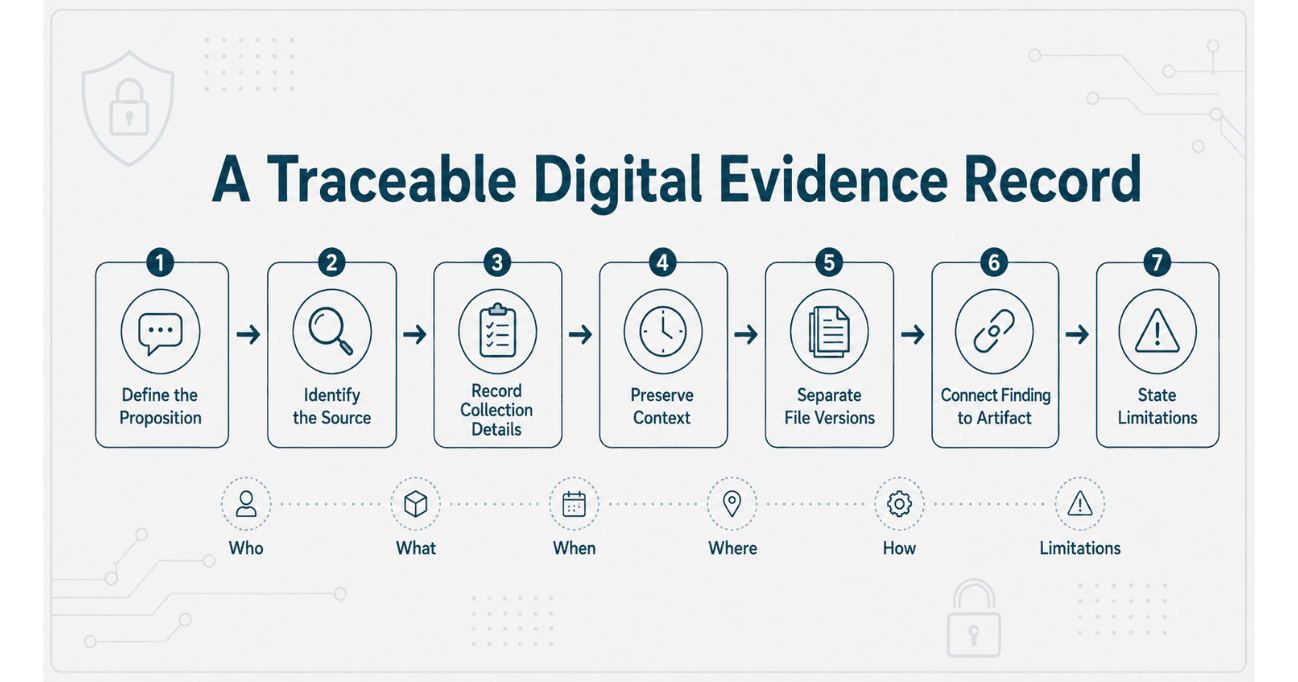
1. Define the proposition
State what the artifact is intended to show.
This screenshot documents the consent interface visible during the recorded session.

This HAR entry documents a request recorded by the browser during the capture window.

This export contains records obtained from the specified platform account using the stated export process.
2. Identify the source
- Device
- Account
- Website
- Application
- Cloud platform
- Server
- Third-party provider
- Witness
3. Record collection details
- Date and time
- Time zone
- Collector or reviewer
- Tool and version
- Account or permission level
- Browser and environment
- Export settings
- Date range
- Collection steps
4. Preserve context
- Earlier and later messages
- Page and visitor journey
- Consent state
- Account details
- Related requests
- Associated storage records
- Related system events
- Limitations and exclusions
5. Distinguish file versions
ORIGINAL — restricted collected file
WORKING — analysis copy
REDACTED — sharing copy
EXTRACT — selected item included in report
6. Use hash values accurately
A hash can help identify a particular file version and compare whether another copy matches it.
A hash does not independently prove:
- Who created the file
- Whether the collection process was correct
- Whether the source system was accurate
- Whether information was omitted
- Whether the file had been altered before hashing
- Whether the exhibit is authentic or admissible
7. Connect findings to artifacts
Finding ID
→ Source
→ Page or account
→ Session or date range
→ Artifact ID
→ File version
→ Relevant excerpt
→ Limitation
8. Record contradictions and unknowns
A credible report should retain:
- Conflicting timestamps
- Missing records
- Unverified account ownership
- Unknown vendor purpose
- Incomplete exports
- Unexpected session behavior
- Alternative explanations
For a broader methodology, use the Website Tracking Evidence Reliability Checklist.
Common Digital Evidence Mistakes
Calling every electronic file self-authenticating
Only defined categories and procedures qualify for self-authentication under applicable rules. The fact that a file was generated electronically does not create automatic self-authentication.
Calling authentication the same as admissibility
An authenticated exhibit may still face relevance, hearsay, privilege, completeness, or other objections.
Using screenshots without recording their source
A screenshot should connect to the website, account, device, page, date, time, session, and person who captured it.
Exporting only selected messages
Selective screenshots may remove important context. Record what was excluded and preserve the broader source where appropriate and lawful.
Assuming account ownership proves message authorship
Another person may have used the account. Distinctive content, access records, witness knowledge, and surrounding circumstances may be relevant.
Calling a HAR file a full session replay
A HAR file generally represents browser-network entries exported from the recording tool. It is not a complete visual, device, server, or downstream-processing record.
Ranking evidence formats universally
The strongest evidence depends on the fact being addressed. A packet capture is not inherently more useful than a screenshot for every question.
Describing allegations as court findings
A complaint, enforcement filing, motion-stage ruling, settlement, and final judgment must be described differently.
Using outdated procedural status
Articles about litigation and enforcement should state their source date and be reviewed when proceedings materially change.
Claiming technical evidence proves a privacy violation
Technical evidence may document behavior. Legal conclusions require the relevant statute, jurisdiction, elements, defenses, exceptions, contracts, and full factual record.
What Auditzo Can and Cannot Provide
Auditzo’s website-focused scope
Auditzo supports technical reviews of observable website behavior.
Depending on the selected service and agreed scope, observations may concern:
- Website pages and visitor journeys
- Visible consent interfaces
- Browser-network requests
- Third-party hostnames
- Cookies and browser storage
- Initial or no-interaction behavior
- Separate consent states in a Manual Evidence Audit
- Screenshots and selected technical artifacts
- Finding-to-artifact traceability
- Technical limitations
- Remediation-oriented observations
Automated Auditzo reports
Automated reports provide initial technical observations within the configured automated scope.
They do not include:
- Accept or Reject interaction testing
- Human verification
- A downloadable raw-evidence package
- Device forensics
- Messaging-account authentication
- Cloud-account acquisition
- Legal conclusions
- Compliance certification
- An admissibility opinion
Manual Evidence Audits
A scoped Manual Evidence Audit may include:
- Human-reviewed pages and journeys
- Initial, Reject, Accept, Custom, or Returning Visitor states
- Consent-interface screenshots
- Browser-network or HAR review
- Cookie and storage comparisons
- Evidence indexes
- File-version references
- Agreed supporting materials
- Technical findings and limitations
Outside Auditzo’s scope unless separately and expressly agreed
- Mobile-device acquisition
- Text-message authentication
- Social-media account authentication
- Cloud-repository forensics
- Packet-level enterprise network forensics
- Server incident-response investigations
- Biometric database examination
- Expert-witness opinions
- Legal authentication or admissibility determinations
Auditzo boundary: Auditzo provides technical observations and supporting records for legal, privacy, development, and remediation review. It does not provide legal advice, authenticate evidence for a court, certify compliance, determine statutory violations, guarantee admissibility, or predict legal outcomes.
Review the complete Auditzo audit scope and limitations.
Digital Evidence Review Checklist
Purpose
- What fact is the evidence intended to establish?
- Is the fact material to the matter?
- Does the artifact actually address that fact?
Source
- What device, account, website, platform, or system produced it?
- Who had access to the source?
- Can a witness or system record explain the source?
Collection
- Who collected the evidence?
- When and how was it collected?
- Which tool and version were used?
- Were the collection settings recorded?
Context
- Are preceding and following events available?
- Are the relevant page, session, account, or date range identified?
- Were any items filtered, cropped, omitted, or redacted?
Integrity
- Is the original or collected version preserved?
- Are working and redacted copies separately labelled?
- Are hash values tied to specific file versions?
- Is access to sensitive evidence controlled?
Corroboration
- Does another source support the same observation?
- Are witness testimony, platform records, metadata, or related logs available?
- Are contradictory records disclosed?
Limitations
- What was not collected?
- What was outside the reviewer’s access?
- Could retention, deletion, synchronization, or configuration affect the record?
- Are alternative explanations identified?
Procedural accuracy
- Is the source a complaint, order, settlement, regulatory decision, or final judgment?
- Are allegations described as allegations?
- Is the current status recorded?
Legal boundaries
- Has counsel identified the applicable jurisdiction and evidence rules?
- Have hearsay, relevance, privilege, privacy, and completeness issues been considered?
- Does the technical report avoid making unsupported legal conclusions?
This checklist supports technical preparation and review. It is not a substitute for matter-specific legal advice or expert evidence work.
Frequently Asked Questions
What is digital-evidence authentication?
Authentication is the process of providing enough support for a finding that an item is what its proponent claims it is. The required foundation depends on the item, jurisdiction, purpose, and proceeding.
Is authenticated evidence automatically admissible?
No. An authenticated item may still face objections involving relevance, hearsay, privilege, completeness, unfair prejudice, expert testimony, or other rules.
How can text messages be authenticated?
Potential methods include witness testimony, telephone numbers, distinctive content, native exports, device records, provider records, metadata, backups, and forensic extraction. No single method is mandatory in every case.
How can social-media messages be authenticated?
Possible support includes platform account records, account identifiers, witness knowledge, distinctive message content, profile information, login records, native exports, and collection testimony.
Can cloud data be authenticated?
Potentially, yes. Relevant support may include testimony about the export, provider records, account and permission details, audit logs, manifests, certifications, metadata, export settings, and file-version information.
Is a screenshot enough to authenticate digital evidence?
Sometimes a screenshot may be authenticated through witness testimony and surrounding circumstances. In other matters, additional records or native data may be needed. A screenshot does not automatically establish authorship, completeness, or accuracy.
Are HAR files admissible evidence?
No artifact is universally admissible. A HAR file may be offered as a browser-network record, but its proponent may need to establish its source, collection method, relevance, scope, and treatment under the applicable evidence rules.
Does a SHA-256 hash authenticate a file?
A hash can identify a particular file version and help determine whether another copy matches it. It does not independently establish authorship, correct collection, completeness, source accuracy, or admissibility.
What is the difference between chain of custody and authentication?
Chain-of-custody documentation records possession, transfer, access, and handling. Authentication addresses whether the item is what it is claimed to be. Chain-of-custody information may support authentication and integrity, but the concepts are not identical.
Do privacy cases always require forensic evidence?
No. Relevant evidence depends on the claim. Policies, contracts, testimony, system records, notices, configuration files, browser evidence, access logs, and expert analysis may each be important in different matters.
Can Auditzo authenticate text messages, social-media accounts, or cloud data?
No. Auditzo’s standard service scope concerns observable website behavior and agreed browser-based technical artifacts. It does not authenticate messaging accounts, social-media accounts, phones, or cloud repositories.
Can Auditzo determine whether a privacy violation occurred?
No. Auditzo documents technical observations. Qualified counsel, regulators, and courts determine statutory coverage, legal requirements, violations, liability, and evidentiary use.
Request a Website Tracking Evidence Review
Auditzo supports law firms, privacy teams, agencies, website operators, and development teams that need a clearer technical record of website tracking and consent behavior.
A scoped Manual Evidence Audit may include:
- Defined websites, pages, and journeys
- Recorded browser and regional environment
- Initial, Reject, Accept, Custom, or Returning Visitor sessions
- Consent-interface screenshots
- Browser-network and HAR review where agreed
- Cookie and browser-storage comparisons
- Third-party hostname observations
- Finding-to-artifact references
- Evidence indexing
- Technical limitations
- Remediation-oriented observations
Discuss a scoped Manual Evidence Audit or review website privacy evidence support for law firms.
For initial automated visibility into technologies, cookies, browser storage, and third-party requests, teams can run an automated website audit.
Scope reminder: Auditzo provides technical observations and supporting records for legal, privacy, development, and remediation review. It does not provide legal advice, certify compliance, authenticate evidence for legal proceedings, guarantee admissibility, determine violations, or predict outcomes.
Official Sources and Further Reading
- United States Courts: Federal Rules of Evidence
- NIST: Digital Evidence
- People v. Kingsberry
- Javier v. Assurance IQ
- CJEU Case C-311/18
- EDPB Binding Decision 1/2021 concerning WhatsApp Ireland
- CNIL Decision concerning Clearview AI
- FTC GoodRx matter
- FTC BetterHelp matter
- In re Meta Pixel Healthcare Litigation case record
- OAIC: Australian Clinical Labs civil penalties
- OAIC: Medibank civil-penalty proceedings
This article provides general technical and educational information. It is not legal advice, an expert opinion, an evidence-authentication determination, a compliance certification, or a prediction concerning any case, regulator, organization, or legal outcome.
Table of Contents
- What Is Digital-Evidence Authentication?
- Authentication, Admissibility, Relevance, and Weight Are Different
- Common Types of Digital Evidence
- How Text Messages May Be Authenticated
- How Social-Media Evidence May Be Authenticated
- How Cloud Data and Platform Exports May Be Authenticated
- Website Tracking and Browser Evidence
- Ten Digital Evidence and Privacy Case Examples
- 1. People v. Kingsberry
- 2. Javier v. Assurance IQ
- 3. Data Protection Commissioner v. Facebook Ireland and Schrems
- 4. WhatsApp Ireland Transparency Decision
- 5. CNIL Enforcement Against Clearview AI
- 6. FTC and DOJ Action Against GoodRx
- 7. FTC Action Against BetterHelp
- 8. In re Meta Pixel Healthcare Litigation
- 9. Australian Clinical Labs Civil Penalty Decision
- 10. OAIC Proceedings Against Medibank
- What These Examples Actually Show
- Digital Evidence Documentation Framework
- Common Digital Evidence Mistakes
- What Auditzo Can and Cannot Provide
- Digital Evidence Review Checklist
- Frequently Asked Questions
- Request a Website Tracking Evidence Review