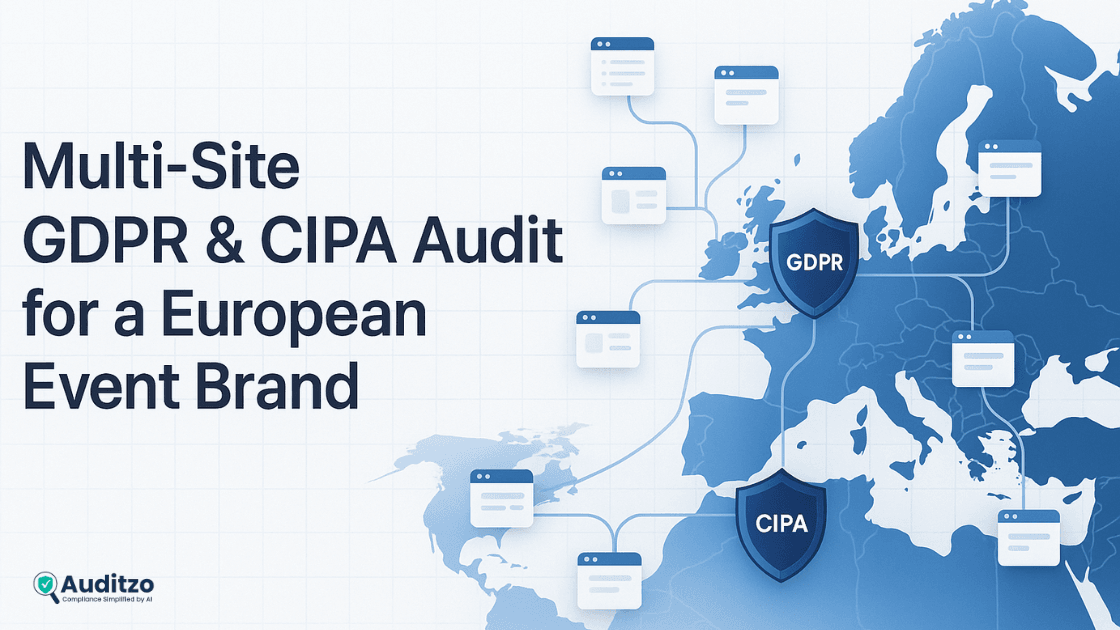
Managing online and offline events across Europe means dealing with rapidly changing pages, new marketing tags, region-specific regulations, and a constant flow of user data. When those elements are spread across multiple domains, risks multiply — especially in jurisdictions like France, Germany, and the United States where regulators are increasingly aggressive.
For IPRNSC, a France-based event management brand running 10 high-traffic event websites, these challenges were no longer theoretical. Hidden trackers were firing before consent, their CMP wasn't blocking anything, and sensitive data was flowing across borders without legal basis.
Within months, the company received multiple GDPR, GDPR-FR (CNIL), CCPA, and CIPA notices.
They knew something was broken — but they didn't know where, why, or how extensively. That's when they brought in Auditzo.
Auditzo's commitment was simple: "We'll show you exactly what's happening, why it's happening, and how to fix it permanently across all your websites."
Real-World GDPR & CIPA Audit Case Study for a French Event Brand (EU + US Traffic)
IPRNSC operates a network of websites serving visitors across France, Germany, and the United States. These platforms support:
- Online registrations
- Hybrid event streaming
- Sponsor activation funnels
- Attendee analytics
- Content hubs for workshops and summits
With 10 interconnected domains and multiple teams managing them, the marketing stack grew quickly — and so did the risk. Their tracking ecosystem depended on tools such as:
- Google Analytics & Ads
- Meta Pixel
- Microsoft Clarity
- Tapad
- Criteo
- Bing Ads
- Additional sponsor tracking pixels
Individually, these are common enterprise tools. Combined — without strong consent governance — they became a liability.
Compliance Challenges: Repeated GDPR, GDPR-FR & CIPA Notices
By mid-2024, regulators in both the EU and US detected violations across the client's domains. The notices highlighted issues under:
- GDPR (EU-wide)
- GDPR-FR (CNIL)
- CCPA (California)
- CIPA (U.S. session replay restrictions)
Key Findings from Regulators
1. Trackers firing before consent (major GDPR-FR violation)
Even users who selected Reject All were tracked by:
- Tapad
- Criteo
- Clarity
- Meta Pixel
- Google Ads/Analytics
Pre-consent tracking is when cookies or scripts begin collecting personal data before the user has made a clear choice on the consent banner — a direct violation across EU and US markets.
These tools captured:
- IP address
- Device fingerprints
- Navigation history
- URLs & referrers
- Interaction behavior
2. CMP failure (the root cause)
Their Consent Management Platform wasn't blocking anything because:
- Scripts loaded before the CMP
- GEO rules weren't implemented
- Tag Manager shortcuts bypassed consent
- Mobile users were automatically "accepted"
3. Systemic issues across all 10 websites
Because pages were cloned, all domains inherited:
- Misconfigured CMP
- Faulty sequencing
- Legacy scripts
- Duplicated containers
4. High legal exposure
This meant potential:
- GDPR & CNIL fines
- CIPA litigation for unlawful "interception"
- Loss of user trust
- Reputational harm in the privacy ecosystem
IPRNSC needed clarity — and a fix that wouldn't break their marketing stack.
Hidden Trackers, Failed CMPs & Pre-Consent Data Flows
Auditzo's forensic investigation revealed the true scope within days.
(Insert screenshot of Auditzo Tracker Map)
Across all 10 websites:
- Trackers fired 5–12 seconds before the consent banner
- Data was sent to 18+ external domains before consent
- HAR logs captured personal identifiers on page load
- Tag Manager custom HTML blocks bypassed consent logic entirely
Examples of real pre-consent calls:
https://analytics.google.com/g/collect?...
https://trc-events.criteo.com/...
https://px.tapad.com/activity?...
https://c.clarity.ms/collect?...
As covered in Auditzo's guide on HAR-based courtroom evidence, this type of documentation is essential when legal teams must demonstrate compliance.
CMP wasn't just misconfigured — it was ineffective.
Auditzo discovered that:
- CMP initialized too late
- Consent states weren't enforced
- GEO logic failed for Germany, France, and the US
- Scripts fired unconditionally
The issue wasn't negligence — it was broken infrastructure.
How Auditzo Ran a Courtroom-Ready Multi-Site GDPR Audit (EU + US)
A multi-site GDPR audit reviews how data flows across several domains that share infrastructure, tags, consent logic, and user journeys. Most enterprises underestimate how interconnected — and how risky — this ecosystem can be.
Auditzo applies a forensic methodology trusted by legal teams and regulators.
(Insert screenshot of forensic evidence timeline)
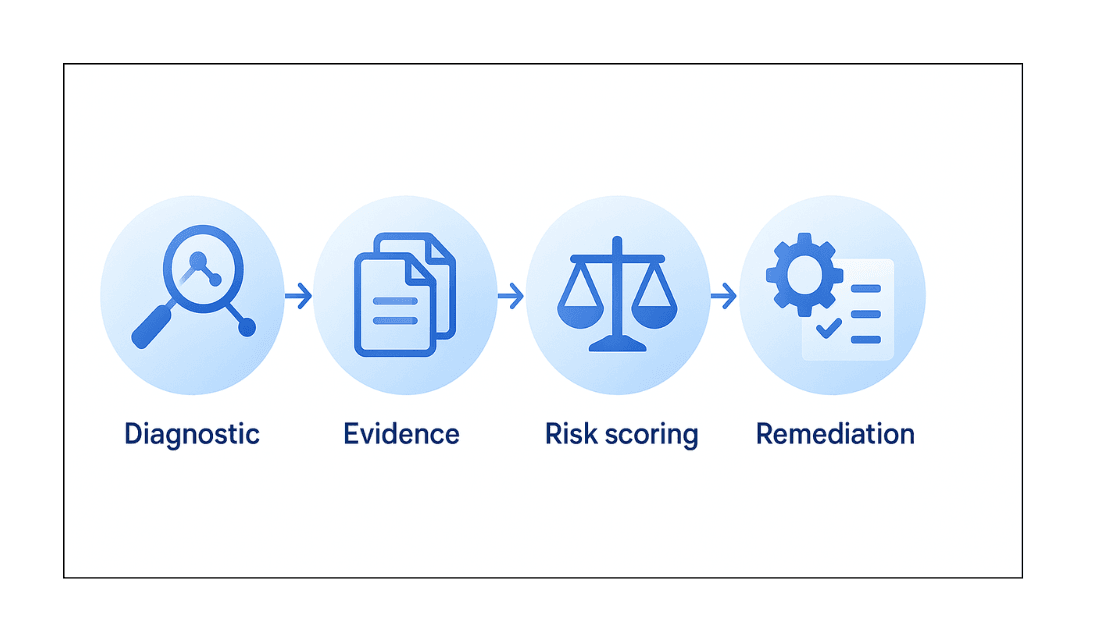
Step 1 — Multi-Site Diagnostic
Auditzo reviewed:
- Full network activity
- Tag Manager sequencing
- CMP event lifecycle
- Script priority chains
- Session replay behavior
- France/Germany/US-specific journeys
Step 2 — Forensic Evidence Collection
Following the structure of the GDPR evidence report template, Auditzo captured:
- IP transmissions
- Payload data
- Device fingerprints
- Cookie sync chains
- Redirect loops
Everything was compiled into a courtroom-ready evidence dossier.
Step 3 — Risk Scoring & Tracker Categorization
Each tracker was scored based on:
- Sensitivity of collected data
- Cross-device matching activity
- Pre- vs post-consent behavior
- CNIL & EU compliance risk
- CIPA exposure for U.S. users
This helped the team answer: What must be blocked immediately, what can stay, and what needs conditional activation?
Step 4 — Developer Remediation Blueprint
Auditzo delivered a clear, engineering-focused remediation plan:
- Rebuild firing rules
- Enforce hard-blocking for unsafe trackers
- Implement CNIL-compliant "prior consent mode"
- Correct CMP sequencing
- Remove legacy scripts
(Insert CMP workflow architecture diagram)
Once fixes were implemented, Auditzo completed a second audit to confirm compliance.
If you're managing multiple event or media websites across EU and US regions and suspect hidden trackers, you can run a similar forensic audit for your organization. Start your preliminary scan today.
Technical Fixes, Optimizations & Continuous Monitoring
Auditzo partnered with the client's dev, marketing, and legal teams to ensure changes were implemented correctly and sustainably.
1. CMP Rewiring
- CMP now loads before any vendor script
- Marketing tags moved into controlled GTM containers
- Mobile logic updated to remove dark patterns
- Prior-consent mode aligned with CNIL guidance (France/Germany audiences)
2. Pre-Consent Blocking
All vendors — Tapad, Criteo, Meta, Clarity, etc. — are now blocked until explicit consent is provided.
3. Geo-Aware Compliance
Traffic is now segmented for:
- EU: GDPR + GDPR-FR
- California: CCPA
- United States: CIPA restrictions for session replay
4. Monthly Monitoring Subscription
IPRNSC opted for continuous coverage:
- Daily automated scans
- Weekly human audits
- Alerts for new or suspicious trackers
- Pre-production checks
- Quarterly compliance reviews
This is indispensable for fast-changing event websites.
Results: Zero Violations, Higher Trust & Lower Risk
Within 4 weeks, Auditzo helped the client achieve full GDPR & CIPA compliance.
Key Results at a Glance
- 10 websites audited (France, Germany, US traffic)
- 18+ hidden trackers identified
- 100% pre-consent data leaks eliminated
- 4 weeks to complete remediation
Compliance Outcomes
- All websites now compliant with GDPR + GDPR-FR + CIPA
- CMP enforcement is consistent across devices
- No new notices months after implementation
Technical Improvements
- 14 legacy scripts removed
- All unauthorized cross-device tracking eliminated
- GTM infrastructure stabilized
- Stronger cross-domain governance
Business Impact
- Lower legal exposure
- Restored trust for advertisers and attendees
- Accurate data with lawful basis
- Sustainable internal compliance process
Client Insight
For the first time, the team could clearly see how data moved across their ecosystem — and how to control it. The clarity and guidance led them to extend their partnership with Auditzo for long-term monitoring.
Why the Client Chose Auditzo
IPRNSC evaluated several compliance vendors. Auditzo stood out for four reasons:
1. Evidence-First Methodology
Most scanners produce surface-level reports. Auditzo provides timestamped, regulator-ready evidence.
2. Deep Technical + Legal Expertise
Auditzo speaks the language of:
- Developers
- Legal teams
- Marketing operations
- Privacy officers
3. Multi-Site Scalability
Auditzo can audit hundreds of pages across dozens of domains in parallel — essential for event and media companies.
4. Continuous Protection
"In most multi-site audits we run for event and media brands, we see the same pattern: CMPs are installed, but trackers still fire before consent due to Tag Manager shortcuts and legacy scripts." This field insight resonated with the client and demonstrated real-world experience.
Frequently Asked Questions
Q1: What was the biggest issue Auditzo discovered?
The most critical problem was pre-consent tracking across all 10 domains, a major GDPR-FR and CIPA violation.
Q2: Why did the client's CMP fail?
It loaded too late, didn't block scripts, and Tag Manager allowed vendors to bypass consent.
Q3: How quickly was the problem resolved?
Auditzo completed the audit and remediation roadmap in 4 weeks, followed by continuous monitoring.
Q4: What is pre-consent tracking?
Pre-consent tracking is when cookies, pixels, or scripts collect user data before the user has made a choice on the consent banner — making it unlawful in the EU and risky in the US.
Summary — What Auditzo Delivered
- Multi-site GDPR, GDPR-FR, CCPA & CIPA forensic audits
- Identification of 18+ hidden tracking vendors
- Full CMP restructuring and sequencing corrections
- 100% elimination of pre-consent data flows
- Legally defensible evidence package
- Long-term monitoring partnership
- Complete compliance restored across 10 domains
Want results like these? Run your free compliance audit now.
https://www.auditzo.com/audit-now
Or explore more real-world examples and compliance resources:
- GDPR + CCPA Case Study: https://www.auditzo.com/case-study/trucart-gdpr-ccpa-compliance-audit-case-study
- CIPA Compliance Audit: https://www.auditzo.com/case-study/cipa-forensic-audit-law-firm
- GDPR Evidence Template: https://www.auditzo.com/blog/gdpr-evidence-report-template-cookie-violations
- Courtroom Evidence Guide: https://www.auditzo.com/blog/screenshots-logs-har-files-courtroom-evidence